

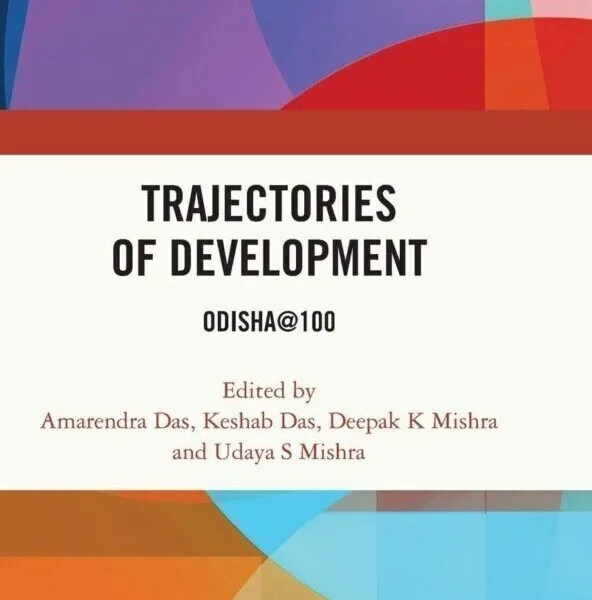
| Type | Book chapter |
| Title | “Export Performance and Policy Dynamics in Odisha: An Evolving Industrial Landscape” |
| Authors | Jaya Prakash Pradhan · Tareef Husain |
| In | Trajectories of Development: Odisha@100 (eds. A. Das, K. Das, D. K. Mishra & U. S. Mishra) |
| Published | 2026 · Routledge (Taylor & Francis) · pp. 177–209 |
| Read | View the book (Routledge) |
This is a plain-language summary of “Export Performance and Policy Dynamics in Odisha,” a chapter I co-authored with Tareef Husain in Trajectories of Development: Odisha@100 (Routledge, 2026).
In short:
- After decades as one of India’s least-industrialised states, Odisha staged a turnaround: manufacturing rose from about 9% of its economy to 18.8% — now above the national average.
- Its exports surged even faster, roughly tripling their share of India’s total to nearly 5%, lifting Odisha into the country’s top exporting states.
- But the boom rests on a narrow base — metals and minerals are about 70% of exports, three regions produce 95%, and the capital-intensive industries driving it generate relatively few jobs.

From laggard to contender
For most of the post-independence period, Odisha was the textbook case of an industrial laggard — the least industrialised of India’s major states between 1960 and the late 1980s, its manufacturing stuck near 9% of the state economy while the national figure sat 6–7 points higher. Even after the 1991 liberalisation, it struggled for over a decade to move the needle.
Then, from the mid-2000s, the picture changed. Manufacturing’s share of Odisha’s economy climbed steadily, crossing the national average and reaching 18.8% by 2021–22 — a complete reversal of historical patterns. In real terms, manufacturing output expanded nearly eight-fold between 2005–06 and 2021–22.

The export surge
The export story is even more dramatic. Odisha’s exports grew faster than the national average in almost every period — and spectacularly so at the end, posting growth of 55% and 59% in 2020–21 and 2021–22, against India’s −3% and 46%. As a result, Odisha’s share of India’s total exports roughly tripled, from about 1.4% in the early 2000s to nearly 5% by 2021–22.

The acceleration is recent and real, and it lifted Odisha into the ranks of India’s top exporting states. Here is how its export growth compared with the national rate:
| Period | Odisha’s export growth | India’s export growth |
|---|---|---|
| 2000–01 to 2004–05 | 21.4% | 16.9% |
| 2005–06 to 2009–10 | 23.8% | 18.1% |
| 2010–11 to 2014–15 | 12.7% | 18.2% |
| 2015–16 to 2019–20 | 30.6% | 3.6% |
| 2020–21 | 55.4% | −2.7% |
| 2021–22 | 58.5% | 45.8% |
Policy: the engine behind the change
The chapter’s central argument is that this turnaround was policy-made. Odisha’s industrial and export policy grew steadily more deliberate and sophisticated:
- 1992 & 1996 industrial policies — the first to treat exports as a priority and to look beyond resource-based industries.
- Odisha Industries (Facilitation) Act, 2004 — a robust single-window clearance system and a “Land Bank” for industry; a genuine turning point.
- Odisha Export Policy 2014 — the state’s first standalone export policy, with a target to nearly triple exports over a decade.
- Industrial Policy Resolution 2015 — explicit focus on IT, electronics, biotech, and automotive alongside traditional sectors.
- IPR 2022 + Export Policy 2022 — aiming for a top-5 export-state ranking and ₹3.5 lakh crore in exports by 2026–27, with new sectoral policies for IT, textiles, logistics, and data centres.
The throughline is a shift from ad-hoc incentives toward targeted, sector-specific strategy — and, crucially, toward technology- and skill-intensive industries rather than minerals alone.
The catch: a narrow base
Here the chapter resists any triumphalist reading. The growth is real, but it is strikingly concentrated — on three fronts.
By sector. Nearly all of Odisha’s exports come from five categories, and just two of them — metallurgical products and minerals — have made up over 70% of exports through most of the period. The two trade places as commodity cycles turn (metals were ~68% in 2021–22; minerals peaked near 58% in 2010–11 before falling to 15%), but together they dominate. Higher-value and labour-intensive sectors — engineering and chemicals, electronics and software, textiles, processed foods — are growing but still small.
By place. Exports are geographically lopsided. Three regions generate 95% of the total, and a single district — Jharsuguda — accounts for 31% of all state exports on its own:
| Region | Share of exports | Led by |
|---|---|---|
| Western Odisha | 47% | Jharsuguda (31%), Sambalpur, Sundargarh |
| Eastern Odisha | 28% | Jagatsinghapur, Jajapur (near Paradip Port) |
| Central Odisha | 20% | Angul |
| Southern Odisha | 3% | Rayagada |
| Northern Odisha | 2% | Baleshwar |
There’s a genuine surprise here: Western Odisha, historically the least developed and least policy-favoured part of the state, is now its export powerhouse — on the strength of mineral wealth and large metallurgical plants.
By type of industry. Because the exports are dominated by capital-intensive metals and minerals, the boom has created comparatively few jobs. The chapter is pointed about this: the resource-based model has not translated into broad employment or balanced regional development.
How export-ready is Odisha?
Beyond performance, the chapter uses NITI Aayog’s Export Preparedness Index to gauge Odisha’s underlying readiness. The state averaged 10th of 36 states and union territories over 2020–22 — creditable for a former laggard — but the pillar breakdown shows exactly where the work remains:
| EPI pillar (2020–22 avg.) | Odisha’s rank |
|---|---|
| Export Policy | 7th — its strongest |
| Export Performance | 9th |
| Export Infrastructure | 11th |
| Business Environment | 16th — its weakest |
The pattern is telling: Odisha now writes excellent export policy, but the on-the-ground business environment — ease of doing business, access to finance, regulatory efficiency — lags well behind. Good policy has run ahead of good administration.
Why it matters
Odisha’s two decades offer a clear lesson in what place-based industrial policy can — and can’t — do. Sustained, increasingly sophisticated policy genuinely transformed a stagnant, mineral-dependent economy into a fast-growing manufacturing and export contender. But it has not yet broken the state’s dependence on a handful of capital-intensive, resource-based industries clustered in a few districts. The unfinished agenda is diversification: into higher-value and labour-intensive sectors that create jobs, and across the southern and northern regions that the boom has so far passed by. Whether Odisha’s ambitious recent targets are met will depend less on writing new policy than on closing the gap between policy and implementation.
Cite this chapter
Pradhan, J. P., & Husain, T. (2026). Export performance and policy dynamics in Odisha: An evolving industrial landscape. In A. Das, K. Das, D. K. Mishra, & U. S. Mishra (Eds.), Trajectories of Development: Odisha@100 (pp. 177–209). Routledge (Taylor & Francis). https://doi.org/10.4324/9781003616788
Related on this site
- The co-author’s profile: Dr. Tareef Husain — Charting New Paths in Regional Economics
Further Reading
As an Amazon Associate I earn from qualifying purchases.