


| Type | Edited volume (festschrift) |
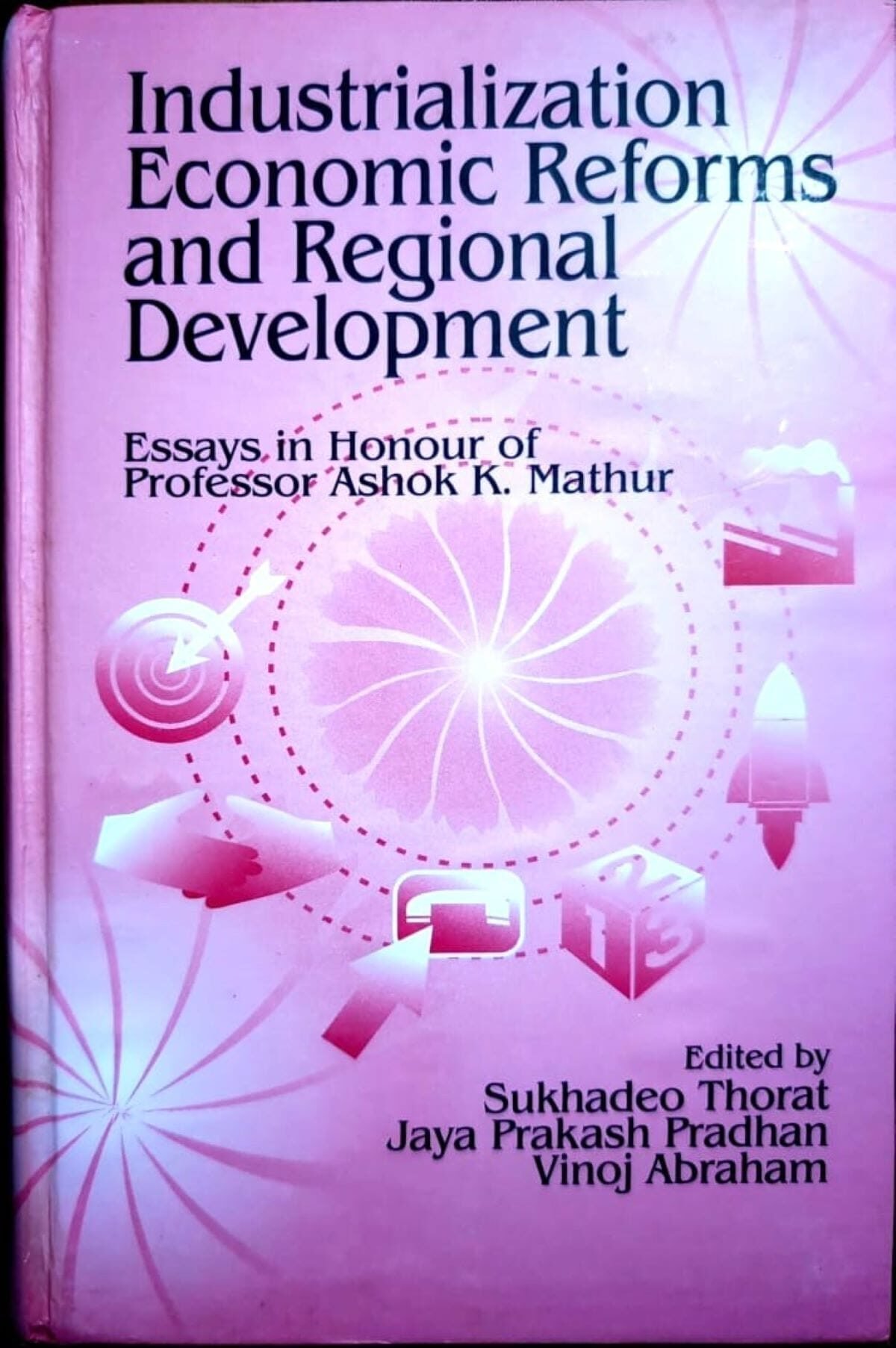
| Title | Industrialization, Economic Reforms and Regional Development: Essays in Honour of Professor Ashok Mathur |
| Editors | S. K. Thorat · J. P. Pradhan · V. Abraham |
| Honouring | Professor Ashok Mathur |
| Published | 2005 · Shipra Publications, New Delhi |
| Read | Introduction (PDF) · Buy on Amazon |
This is an overview of Industrialization, Economic Reforms and Regional Development, a festschrift I co-edited with S. K. Thorat and V. Abraham in honour of Professor Ashok Mathur.
In short:
- The volume honours Professor Ashok Mathur, whose work from the 1960s onward shaped how India understands regional disparity, human capital, and the link between industry and agriculture.
- A new generation of scholars extends his ideas across three themes: regional development, the changing world of work, and India in a globalising economy.
- The running finding is one Mathur anticipated decades earlier — that economic reform widened the gaps between Indian regions, and that closing them needs deliberate, multi-level policy.
The scholar being honoured
Ashok Mathur’s career took him from Punjab University to Cambridge and the London School of Economics, driven by a set of questions that would occupy him for decades: why do some Indian regions prosper while others lag, how does education transform a workforce, and what role should government play in steering development? Over the following decades he turned those questions into a body of work that became foundational to Indian development economics.

Five ideas run through his contribution:
| Idea | What Mathur argued | Landmark work |
|---|---|---|
| Growth balance | Balanced and unbalanced growth are complementary strategies, not rivals | Oxford Economic Papers (1966) |
| Regional disparities | Pioneered systematic analysis of why Indian states grow at different rates | Economic Development and Cultural Change (1983) |
| Human capital | Investment in education sends ripple effects through the whole economy | research at JNU |
| Industry–agriculture | The two sectors are interdependent, not separate compartments | Development and Change (1990) |
| Employment | Job creation must be understood at every level, from village to metropolis | — |
What the volume covers
The contributors carry Mathur’s questions into contemporary India, across three connected themes:
| Theme | What the studies examine |
|---|---|
| A tale of two Indias (regional development) | Widening interstate gaps since the reforms; the particular challenges of the North-eastern states; manufacturing’s role in regional inequality; productivity differences in the informal sector |
| The changing world of work | The rural-to-urban shift in small enterprises; the IT sector’s transformative impact; the growing feminisation of informal work; new employment patterns in a globalised India |
| India in a globalising world | The impact of the 1991 reforms; the evolution of the banking sector; the software success story; the relationship between women’s status and economic growth |
The common thread is that the post-1991 reforms brought real opportunity but also widening regional and sectoral gaps — most pronounced in manufacturing and the informal economy.
What it means for policy
The studies point in a consistent direction. Regional development needs multi-level planning and a deliberate infrastructure focus in lagging regions, with strategies tailored to the informal sector rather than imported wholesale. On employment, the priorities are support for rural enterprises, technical skilling, attention to the specific needs of women workers, and keeping the IT sector competitive. And on the wider framework, the volume argues for balancing global opportunity with local protection, modernising the banking sector, promoting innovation, and pursuing gender-sensitive development.
Why it matters
The questions that occupied a young economist in the 1950s — about equity, urbanisation, global competition, and inclusion — are still India’s questions today. What this volume shows is that Mathur’s foundational ideas remain useful tools for answering them, and that his influence lives on not only through those ideas but through the institutions he helped build and the scholars he mentored. Development economics, as the collection reminds us, is finally not about models alone but about improving lives across a vast and unequal country.
Read the academic abstract
This volume honours Professor Ashok Mathur’s contributions to development economics through a collection of empirical studies examining India’s industrialisation, economic reforms, and regional development. The papers analyse three key themes: regional economic disparities, labour-market transformations, and the impacts of economic reforms and globalisation. The regional-development studies reveal widening interstate disparities after the 1991 reforms, particularly pronounced in manufacturing and the informal sector. Labour-market analyses demonstrate significant rural–urban shifts in employment, a growing feminisation of informal work, and the emergence of the IT sector as a major employer. Papers examining economic reforms highlight both the opportunities and the vulnerabilities of global integration, while emphasising the need for complementary domestic policies in banking, industrial development, and human-capital formation. The volume makes theoretical and empirical contributions to understanding India’s development challenges through rigorous sectoral and spatial analysis, and offers evidence-based policy insights for promoting balanced regional growth, productive employment, and globally competitive industrial development while ensuring social inclusion.Cite this book
Thorat, S. K., Pradhan, J. P., & Abraham, V. (Eds.). (2005). Industrialization, Economic Reforms and Regional Development: Essays in Honour of Professor Ashok Mathur. New Delhi: Shipra Publications.
Read the introduction (PDF) → · Buy on Amazon →
As an Amazon Associate, purchases made through the Amazon link may earn a commission at no extra cost to you.
Further Reading
As an Amazon Associate I earn from qualifying purchases.