

| Type | Working paper |
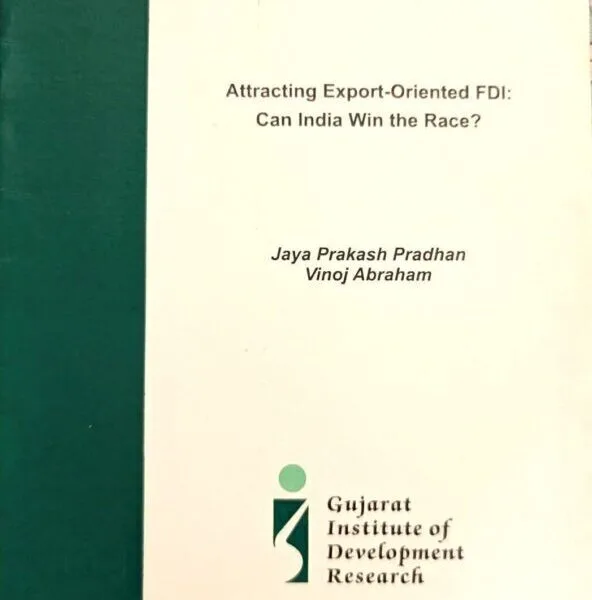
| Title | “Attracting Export-Oriented FDI: Can India Win the Race?” |
| Authors | Jaya Prakash Pradhan & Vinoj Abraham |
| Published | 2005 · GIDR Working Paper No. 156 · Gujarat Institute of Development Research, Ahmedabad |
| Focus | India’s attractiveness as a host for export-oriented FDI, vs competitors like China |
| Read | Working paper (PDF) |
This is a plain-language summary of “Attracting Export-Oriented FDI: Can India Win the Race?” (Pradhan & Abraham, GIDR Working Paper No. 156, 2005).
In short:
- When global firms set up in India, they have mostly served the domestic market rather than exporting — foreign companies supplied only about 5% of India’s exports around 2001, versus roughly 50% in China.
- The study traces this to four barriers: a skills gap, infrastructure bottlenecks, policy/implementation gaps, and a failure to use investment treaties as a tool.
- Early success stories (Hyundai, Philips) showed the potential — the question was whether India could fix the fundamentals to win more of this investment.
The big question
When multinationals build factories in a developing country, some countries turn that investment into an export powerhouse — China being the obvious example — while others mainly get firms serving the local market. This study, by Jaya Prakash Pradhan and Vinoj Abraham, asks why India had historically struggled to attract export-oriented foreign investment, and what it would take to change. The stakes are real: export-oriented FDI tends to bring advanced technology and management practices, build supplier linkages, earn foreign exchange, help domestic firms learn global markets, and — because it sells abroad — is less likely to crowd out local companies than market-seeking investment.
A tale of two countries
The gap between India and China on this measure was stark, and it’s the natural starting point.
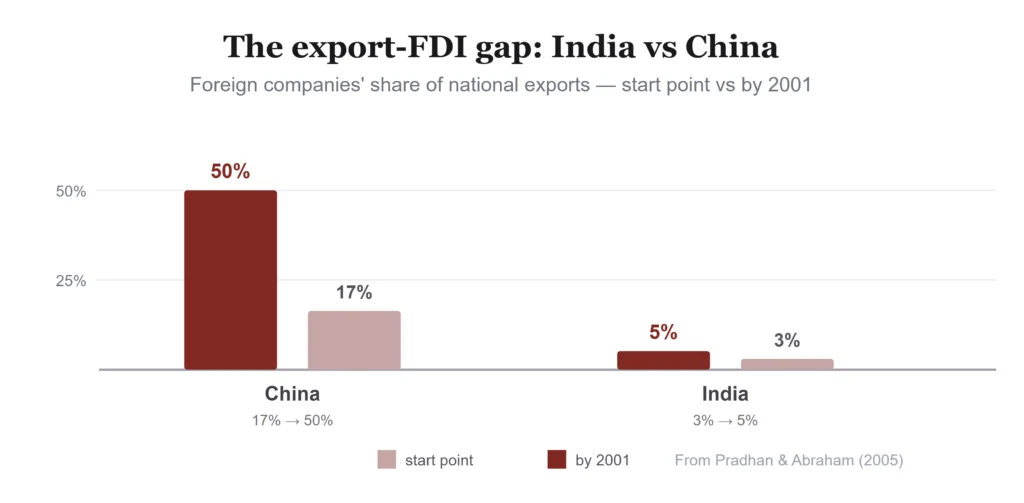
Around 2001, foreign companies accounted for roughly 50% of China’s exports but only about 5% of India’s. And the trajectories had diverged just as sharply: China’s foreign-firm export share climbed from about 17% to 50%, while India’s crept from 3% to just 5% — effectively stuck. Multinationals were investing in India, but to sell to India, not to export from it.
What was holding India back
The study identifies four location-specific barriers that lowered India’s attractiveness for export-oriented investment relative to its competitors.
The first is skills: India’s general workforce was less skilled on average, with mean years of schooling around 5.06 versus China’s 6.35 — a gap that weighs directly on export competitiveness. The second is infrastructure, where India ranked lowest among 11 competing countries; 73% of foreign investors rated power supply “bad” and 71% said the same of roads, with ports and airports also needing modernisation. The third is policy and implementation: genuine reforms (automatic approvals, higher FDI caps, lower trade barriers) had improved the headline regime, but complex state-level rules and weak ground-level delivery persisted. And the fourth, more technical but telling, is the failure to use bilateral investment treaties (BITs) as an active tool to court export-oriented investors, as some competitors had.
Signs of change
It wasn’t all discouraging. Even by 2005, the study noted rising global interest in India as a manufacturing base, with concrete early successes: Hyundai, initially sceptical, had moved to exporting tens of thousands of vehicles from India; Philips had invested around $150 million to build an export hub; and Same Deutz-Fahr was using India as a base to export tractors. At the firm level, the study found that foreign affiliates with moderate (rather than full) foreign ownership tended to export more, and that R&D, productivity, marketing investment, and government export incentives all helped foreign affiliates’ export performance.
The road ahead
The policy prescriptions follow directly from the barriers: modernise infrastructure urgently, invest in skills, streamline and harmonise regulation across central and state levels, strengthen investment promotion, make active use of bilateral investment treaties, and sharpen export incentives. The underlying message is that India had real potential as an export base — the early success stories proved it — but realising it would require fixing fundamentals (infrastructure and skills above all) through coordinated action by both central and state governments.
Read the academic abstract
This paper examines the attractiveness of India as a host to export-oriented FDI (EFDI) in terms of a range of location-specific factors such as labour cost, skill, infrastructure, natural resources, openness, and bilateral investment treaties (BITs). The study finds that a low level of general skills, infrastructure bottlenecks, and the failure to use BITs as tools for attracting EFDI are the main factors lowering India’s attractiveness compared with others. To better understand what matters at the firm level, the study also analyses the role of various firm-specific factors important for the export performance of foreign affiliates in Indian manufacturing.Cite this working paper
Pradhan, J. P., & Abraham, V. (2005). Attracting export-oriented FDI: Can India win the race? (GIDR Working Paper No. 156). Ahmedabad: Gujarat Institute of Development Research.
Read the working paper (PDF) →
Related on this site
- What foreign firms in India actually did with exports, years later: Beyond Local Markets: The Evolution of Foreign Companies in India
- The firm-level drivers of manufacturing export success: Made in India: What Makes Companies Successful Global Exporters?
- The regional geography of India’s export performance: Made in India, Powered by Region: The Geography of India’s Export Success
Further Reading

As an Amazon Associate I earn from qualifying purchases.