

| Type | Working paper |
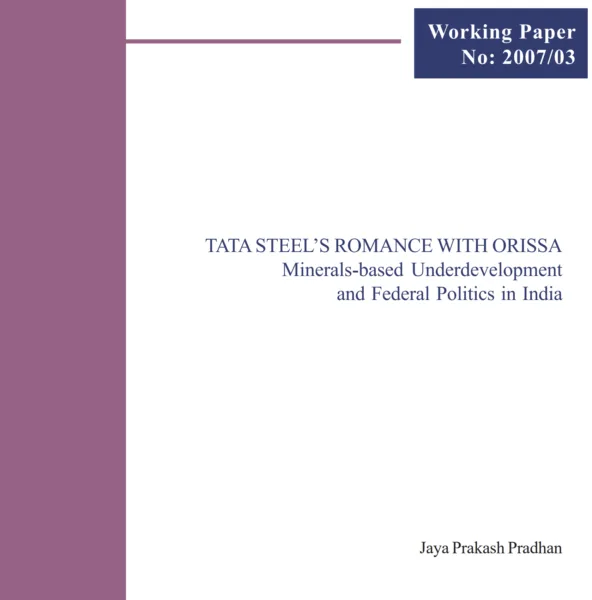
| Title | “Tata Steel’s Romance with Orissa: Minerals-based Underdevelopment and Federal Politics in India” |
| Author | Jaya Prakash Pradhan |
| Published | 2007 · ISID Working Paper No. WP2007/03 · Institute for Studies in Industrial Development, New Delhi |
| Focus | Mineral extraction, value-addition, and regional development in Odisha |
| Read | Working paper (PDF) |
This is a plain-language summary of “Tata Steel’s Romance with Orissa: Minerals-based Underdevelopment and Federal Politics in India” (Pradhan, ISID Working Paper No. WP2007/03, 2007). The interpretations and value judgements described below are the author’s; they are presented here as the argument the paper makes.
In short:
- The paper advances a critical argument: that a century of iron-ore mining in Odisha enriched value-adding regions elsewhere while leaving the mineral-bearing state with the costs.
- Its central evidence is an asymmetry — on the author’s estimates, Odisha retained only about 15% of the value addition and 9% of the jobs generated from its minerals.
- It frames this as a question of federal political economy: how mineral wealth, value-addition, and environmental costs are distributed between Indian states — and argues Odisha should secure far more value-addition at home.
A political-economy argument about resources
This working paper by Jaya Prakash Pradhan uses the long history of Tata Steel’s iron-ore mining in Odisha as a case study in what the author calls minerals-based underdevelopment — the idea that a region can be rich in resources yet poor in development, because the profitable, value-adding activities happen somewhere else. It’s worth being clear at the outset that this is an argument: the paper takes an explicitly critical stance, and the claims and judgements summarised here are the author’s analysis rather than settled fact. Read in that spirit, it’s a pointed contribution to a long-running debate about how resource wealth is shared in a federal system.
The core claim: minerals here, value there
The paper’s central contention is an imbalance between where the minerals were extracted and where the value from them accumulated.
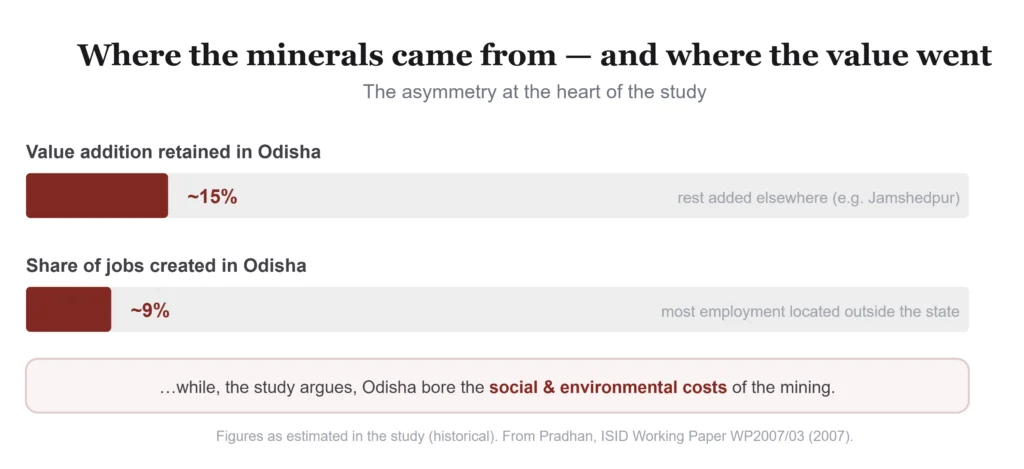
According to the paper, the iron ore was mined in Odisha but the value-adding steel production took place at Tata’s plant in Jamshedpur (in present-day Jharkhand). On the author’s estimates, Odisha retained only about 15% of the value addition from its minerals and around 9% of the associated jobs, while bearing the environmental and social costs of the mining itself. That gap — minerals extracted in one state, wealth and employment concentrated in another — is the empirical heart of the argument.
A century-long arc
The paper traces the relationship across roughly a hundred years.
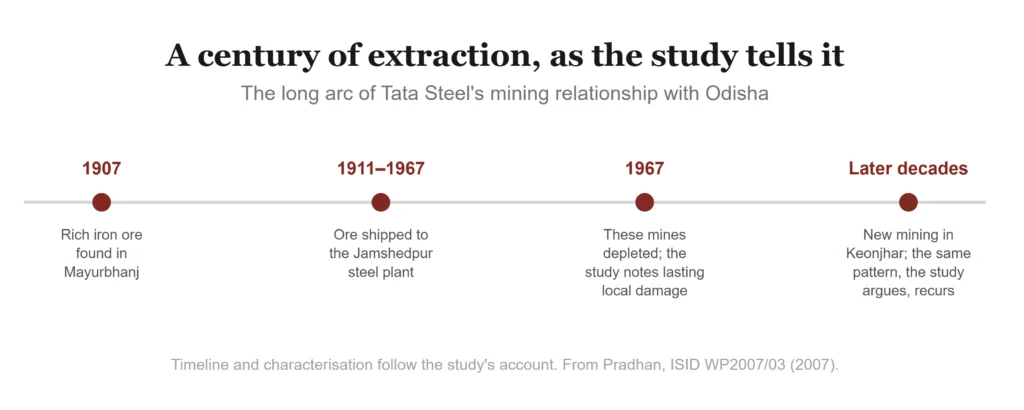
The paper dates the story to 1907, when rich iron-ore deposits were identified in the Mayurbhanj region, and follows extraction to the Jamshedpur plant across 1911–1967, after which, it says, those mines were worked out. It argues that the same dynamic later repeated with new mining in the Keonjhar district, where the paper documents continuing local grievances — pollution affecting agriculture, health complaints, and infrastructure strain — and contends the region remained underdeveloped despite the resource wealth flowing through it. The paper also discusses, as part of its political-economy case, episodes of conflict over land acquisition in the state, including loss of life during protests — a serious matter the author raises to underline the human stakes of these disputes.
The federal-politics angle
What lifts the paper beyond a single company’s story is its argument about federal political economy. In the author’s telling, the framing of minerals as “national” resources allowed other states — where the value-adding industry and infrastructure were located — to benefit from Odisha’s ore, while (the paper contends) the development of Odisha’s own enabling infrastructure, such as ports and railways, was neglected. The paper poses the underlying questions directly: who effectively controls mineral resources in a federal system; how the benefits and costs of extraction should be shared; and what obligations companies and other states owe to the regions whose resources they draw on.
The author’s conclusion
The paper ends with an explicitly advocative position — this is the author’s stance, stated plainly in the working paper. He argues that Odisha should insist on far more value-addition within the state, that mining leases should be tied to local development commitments, and that the state’s representatives should be more assertive about its interests; in the working paper’s strongest formulation, he argues that companies extracting Odisha’s exhaustible minerals without contributing to the local economy should be required to stop. Whatever one makes of that conclusion, the broader point the paper raises — how a resource-rich region can remain underdeveloped when value-addition occurs elsewhere — is a genuine and much-debated question in development economics, and the Odisha case is a vivid way into it.
Read the academic abstract
The following is the author’s abstract; it states his critical argument and conclusion.The paper argues that, historically, Tata Steel extracted Orissa’s exhaustible mineral resources without contributing to local value-added activities, and that other states — Bihar/Jharkhand, West Bengal, and Andhra Pradesh — benefited from the higher-value activities the company located in their territories, treating the minerals as “national” property. It contends that the neglect of Orissa’s enabling infrastructure (such as port and railway facilities) served other states’ narrower economic interests, while Orissa bore the social costs of mining — environmental degradation, wasteland, air and water pollution, and damage to agriculture — without commensurate local value-addition in the post-Independence period. The author concludes by calling on the people, intellectuals, and politicians of Orissa to act in the state’s larger interest, arguing that companies extracting the state’s exhaustible minerals without contributing to its economy should be required to stop.Cite this working paper
Pradhan, J. P. (2007). Tata Steel’s romance with Orissa: Minerals-based underdevelopment and federal politics in India (ISID Working Paper No. WP2007/03). New Delhi: Institute for Studies in Industrial Development.
Read the working paper (PDF) →
Related on this site
- A closely related Odisha development-grievance study: A Tale of Two Regions: Understanding the Koshal Movement in Odisha
- The author’s broader work on uneven regional development: Made in India, Powered by Region: The Geography of India’s Export Success
- Who I am: Professor Jaya Prakash Pradhan
Further Reading
As an Amazon Associate I earn from qualifying purchases.