


| Type | Journal article (empirical study) |
| Title | “Strategic Asset-seeking Activities of Emerging Multinationals: Perspectives on Foreign Acquisitions by Indian Pharmaceutical MNEs” |
| Author | Jaya Prakash Pradhan |
| Published | 2010 · Organizations and Markets in Emerging Economies, 1(2), pp. 9–31 · Vilnius University |
| Data | 139 foreign acquisitions by 52 Indian pharmaceutical firms · 2000–2009 |
| Read | DOI · PDF |
This is a plain-language summary of “Strategic Asset-seeking Activities of Emerging Multinationals: Perspectives on Foreign Acquisitions by Indian Pharmaceutical MNEs” (Pradhan, Organizations and Markets in Emerging Economies, 2010).
In short:
- Indian pharma’s overseas acquisition wave wasn’t only about new markets — it was about buying a capability they lacked: the ability to develop new drugs.
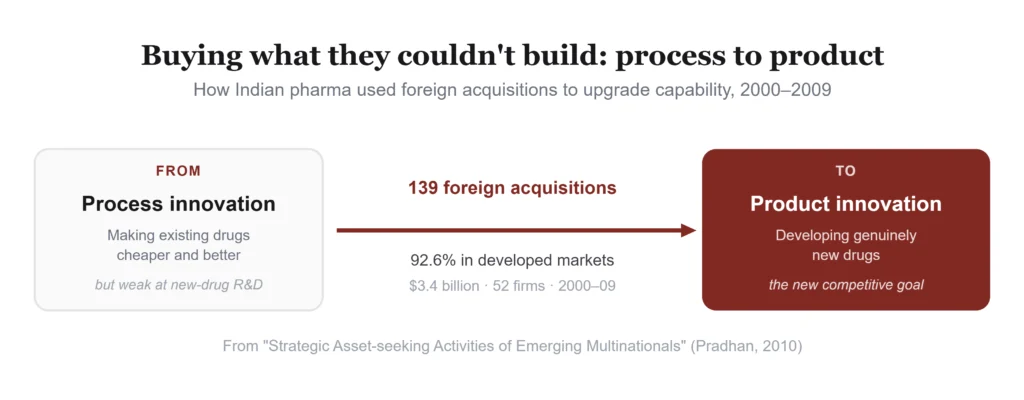
- Between 2000 and 2009, 52 firms made 139 foreign acquisitions worth over $3.4 billion — and 92.6% were in developed countries, where that capability lives.
- Where they bought was shaped by three things: large markets, strong innovation infrastructure, and open investment rules.
Two kinds of capability
For decades, Indian pharmaceutical firms were brilliant at one thing: process innovation — finding cheaper, smarter ways to manufacture existing drugs. What they had not built was product innovation — the capacity to discover and develop genuinely new medicines. After liberalisation in the 1990s sharpened competition and tightened the patent regime, that gap became a strategic problem. Rather than spend years building product-development capability from scratch, many firms chose a faster route: buy it.
Buying capability, not just markets
The scale of the move was significant. Over 2000–2009, 52 Indian pharmaceutical companies made 139 foreign acquisitions, together worth more than $3.4 billion. The telling detail is where: 92.6% of those acquisitions were in developed countries. A firm chasing only cheap markets would have looked to the developing world; firms going overwhelmingly to advanced economies were chasing something else — products, technologies, R&D talent, and the regulatory know-how that comes with them.
| The acquisition wave, 2000–2009 | |
|---|---|
| Indian pharma firms acquiring abroad | 52 |
| Foreign acquisitions made | 139 |
| Total value | $3.4 billion+ |
| Share in developed countries | 92.6% |
This is what the study calls a mixed strategy — using acquisitions to access both new markets and strategic assets at once. Like buying an established workshop rather than apprenticing for years, an acquisition delivers the tools, the expertise, and the customer relationships together.
Where they bought
Indian pharma didn’t acquire just anywhere in the developed world. Three factors shaped the geography of their deals:
| Factor | What they looked for |
|---|---|
| Market size | Countries with large pharmaceutical markets to sell into |
| Innovation infrastructure | High patenting activity and a skilled scientific workforce |
| Investment climate | Liberal, welcoming foreign-investment regimes |
What it means
The episode is a case study in how emerging-market firms can climb the capability ladder quickly. For companies, it shows that acquisitions can be a fast track not just to markets but to competences a firm cannot easily grow at home — provided it can absorb and integrate what it buys. For policymakers, it reframes outward investment: far from draining the home economy, strategic foreign acquisitions can feed back into domestic industrial upgrading. The caveat is real, too — not every firm has the resources to acquire, or the management depth to run what it acquires.
Read the academic abstract
While studies of foreign acquisitions by emerging multinationals (EMNEs) have generally predicted these acquisitions to be driven by both market-seeking and strategic-resource-seeking motivations, concrete analyses on the topic remain limited. This paper contributes to the literature by analysing the overseas acquisition activities of EMNEs from the Indian pharmaceutical sector. Using the general framework of technological change in emerging economies, Indian pharmaceutical firms are identified as having a particular weakness in product-development capabilities as they face intensifying competition under a globalised policy regime. It therefore makes sense for these firms to internationalise through acquisitions of foreign assets that help them access not only new markets but also new products and technologies, overcoming their limited product-development competencies. The empirical findings highlight host market size, intensity of patenting, skill, and a liberal FDI policy regime as key determinants of the geographical distribution of Indian pharmaceutical acquisitions — implying that these EMNEs use acquisition as a mixed strategy of accessing both markets and strategic assets.Cite this article
Pradhan, J. P. (2010). Strategic asset-seeking activities of emerging multinationals: Perspectives on foreign acquisitions by Indian pharmaceutical MNEs. Organizations and Markets in Emerging Economies, 1(2), 9–31. https://doi.org/10.15388/omee.2010.1.2.14294
DOI → · Read the paper (PDF) →
Related on this site
- The earlier chapter of this story — how firm size and liberalisation shaped pharma R&D: The Innovation Race: Firm Size and Policy in Indian Pharmaceutical R&D
- How a firm’s organisational form shapes where it acquires: Beyond Family Ties: How Business-Group Affiliation Shapes Global Expansion
- The same logic in another industry — learning by investing abroad: Innovation Without Borders: How Indian Auto Companies Learn by Going Global
Further Reading
As an Amazon Associate I earn from qualifying purchases.