

| Type | Journal article |
| Title | “Overseas Mergers and Acquisitions by Indian Enterprises: Patterns and Motivations” |
| Authors | Jaya Prakash Pradhan & Vinoj Abraham |
| Published | 2005 · Indian Journal of Economics, 85(33), pp. 365–386 · University of Allahabad |
| Coverage | Overseas M&As by Indian firms · late 1990s–early 2000s |
| Read | Journal · PDF |
This is a plain-language summary of “Overseas Mergers and Acquisitions by Indian Enterprises: Patterns and Motivations” (Pradhan & Abraham, Indian Journal of Economics, 2005).
In short:
- Indian firms’ overseas acquisitions surged from about $11 million in 1998 to over $2 billion by 2001 — part of roughly $5 billion of overseas buying across 1992–2001.
- The software sector led, accounting for about 64% of overseas acquisitions, with most deals aimed at developed markets (especially the US and UK).
- Firms bought abroad for five reasons — market access, technology and talent, operational synergies, growth beyond a limited home market, and competitive survival.
A new kind of Indian company
In the late 1990s, Indian firms began doing something genuinely new: instead of only competing at home, they started buying companies abroad. This study, by Jaya Prakash Pradhan and Vinoj Abraham, maps that early wave of overseas mergers and acquisitions — who was buying, where, and why — and catches the moment when Indian enterprises started becoming global acquirers rather than purely domestic players. Across 1992–2001, Indian firms spent roughly $5 billion on overseas acquisitions, close to half of all the cross-border deal activity involving India.
The pace accelerated dramatically near the end of that period: overseas acquisitions jumped from about $11 million in 1998 to over $2 billion by 2001 — a near two-hundred-fold increase in three years.
Who was buying
The acquisition wave had two distinct engines. The larger was the software surge: India’s booming software sector alone accounted for about 64% of all overseas acquisitions, as IT firms bought their way into a global presence and new markets, targeting developed economies — especially the US and UK. The second was manufacturing, where pharmaceutical companies were particularly active buyers and a diverse range of sectors — from tea to automotive — joined in, generally to acquire technology and established brands. In both cases the strategic tilt was clearly toward the developed world, a sign that Indian firms felt ready to compete in the most demanding business environments.
Why they bought
The study identifies five motivations behind the acquisitions.

Market access came first — acquiring an established company is the fastest way into a new market and its customer base. Technology and talent were a close second: many deals were about obtaining capabilities and skilled people, as when Tata Tea’s acquisition of Tetley brought new packaging and quality methods, or when Ranbaxy’s purchase of RPG (Aventis)’s French generics business added research and market reach. Operational synergies drove others — combining complementary businesses for efficiency, as with Usha Beltron pairing its steel-making with global distribution. Growth beyond borders mattered where the domestic market felt limiting, and competitive survival became a motive in its own right as India’s own economy opened and firms concluded they had to scale globally to endure.
What made a global acquirer
The firms that went abroad weren’t random — they shared identifiable traits, and the profile differed by sector.
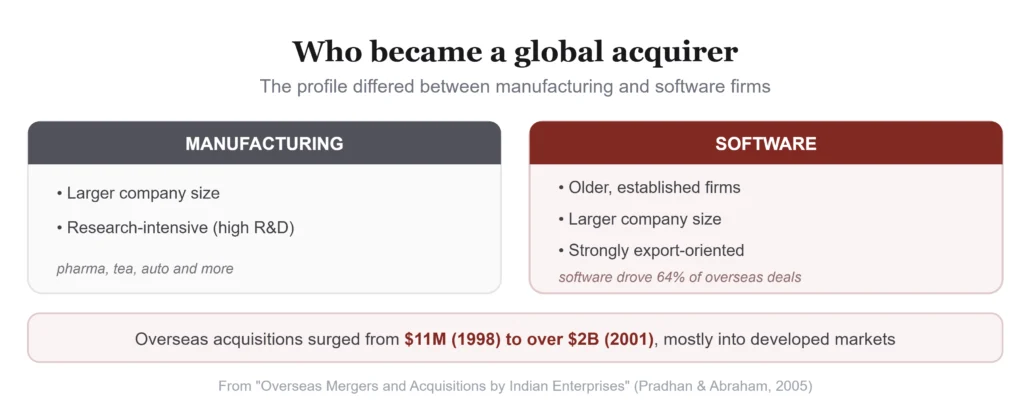
In manufacturing, the overseas acquirers tended to be larger firms with higher R&D intensity — research-led companies confident enough to buy abroad. In software, they tended to be older, established firms that were also large and strongly export-oriented — companies that already knew global markets through exporting and took the next step into ownership. The common thread is capability: across both sectors, it was the more substantial, more globally engaged firms that became acquirers.
Why it matters
This early wave marked a genuine turning point in Indian business history. Companies weren’t merely growing; they were changing character — from domestic players into global competitors — and doing so by acquiring firms in the world’s most sophisticated markets. The study reads this as the beginning of a larger shift: with liberalised policy and rising confidence, overseas acquisition was becoming a standard tool for Indian firms to access markets, acquire technology and skills, build competitive advantage, and secure long-term survival in a globalised economy. Read two decades later — knowing what followed, from Tata–Corus to Tata–JLR — it captures the opening chapter of India’s emergence as a serious force in global business.
Read the academic abstract
This paper examines the patterns and motivations behind overseas M&As by Indian enterprises. It finds that a large majority of overseas M&As originated within the services sector, led by the software industry, and were in overwhelming measure directed towards the developed countries of the world economy. The main motivations of Indian firms’ overseas acquisitions have been to access international markets; to obtain firm-specific intangibles such as technology and human skills; to gain from operational synergies; to overcome the constraints of limited home-market growth; and to survive in an increasingly competitive business environment. The study further finds that overseas acquirers in manufacturing tend to be large-sized and research-intensive, while in software they tend to be older, large-sized, and export-oriented.Cite this article
Pradhan, J. P., & Abraham, V. (2005). Overseas mergers and acquisitions by Indian enterprises: Patterns and motivations. Indian Journal of Economics, 85(33), 365–386.
Journal → · Read the paper (PDF) →
Related on this site
- How those acquisitions fit India’s broader outward-investment story: India Goes Global: The Rise and Evolution of Indian Multinational Enterprises
- The pharma sector’s acquisition strategy in depth: From Local to Global: How Indian Pharma Companies Are Building Their International Future
- The IT side of the story: From Software Startups to Global Giants: The Rise of Indian IT Multinationals
Further Reading


As an Amazon Associate I earn from qualifying purchases.