

| Type | Book chapter |
| Title | “Multinationals from the Indian Software Industry” |
| Author | Jaya Prakash Pradhan |
| In | N. S. Siddharthan & K. Narayanan (eds.), Indian and Chinese Enterprises: Global Trade, Technology and Investment Regimes, pp. 180–210 · Routledge, 2010 |
| Framework | National Innovation System (NIS) |
| Read | Chapter · PDF |
This is a plain-language summary of “Multinationals from the Indian Software Industry” (Pradhan, in Siddharthan & Narayanan (eds.), Indian and Chinese Enterprises, Routledge, 2010).
In short:
- Indian software firms became multinationals not by accident but because of a national innovation system — a web of talent, policy, entrepreneurship, and global advantages working together.
- When they went abroad, they headed mostly for developed markets (69% of overseas subsidiaries) and preferred full ownership (89% wholly-owned subsidiaries).
- The lesson for other developing countries: you have to build the ecosystem, not just hope for the firms.
How a developing country built a tech powerhouse
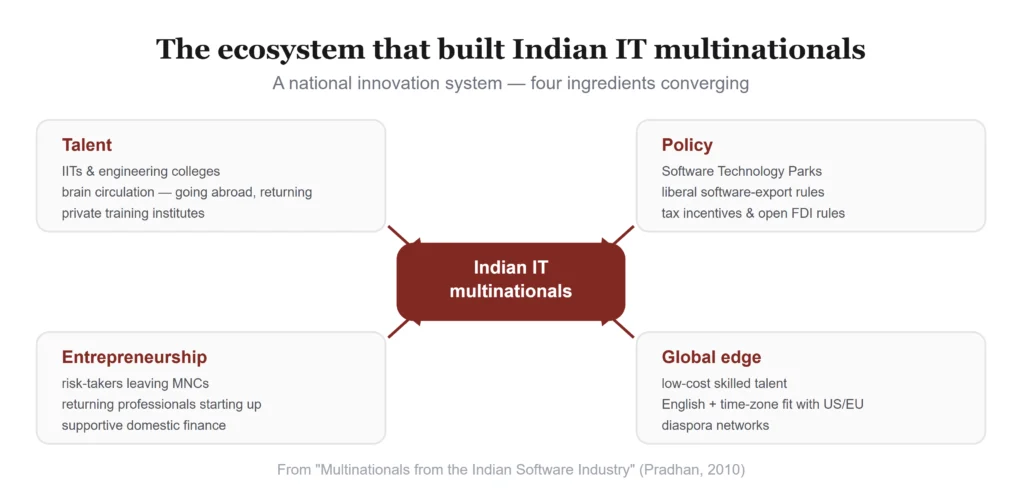
By the late 2000s, Indian IT firms had become some of the most visible emerging-market multinationals in the world — and the obvious question is how. This chapter answers it with a framework rather than a just-so story: the national innovation system (NIS). The idea is that innovation capability isn’t created by any single actor but by an interacting system — government policy, educational and supporting institutions, household decisions, entrepreneurs, and firm strategies all reinforcing one another.
The four ingredients
The system had four reinforcing parts. Talent came from strategic public investment in elite technical institutes (the IITs and engineering colleges), a cultural premium on technical education, “brain circulation” as professionals gained experience abroad and returned, and private institutes filling the gaps. Policy supplied the scaffolding — Software Technology Parks for infrastructure, liberal rules for software exports, tax incentives, and open foreign-investment rules. Entrepreneurship provided the drive: risk-takers spinning out of multinationals, returning professionals starting ventures, family businesses pivoting into IT, and domestic capital to back them. And a set of global advantages — low-cost skilled labour, English fluency, a time-zone complementary to the US and Europe, and diaspora networks — made Indian firms natural partners for Western clients.
Going global
Once competitive at home, these firms expanded abroad deliberately — and the pattern of expansion is revealing.
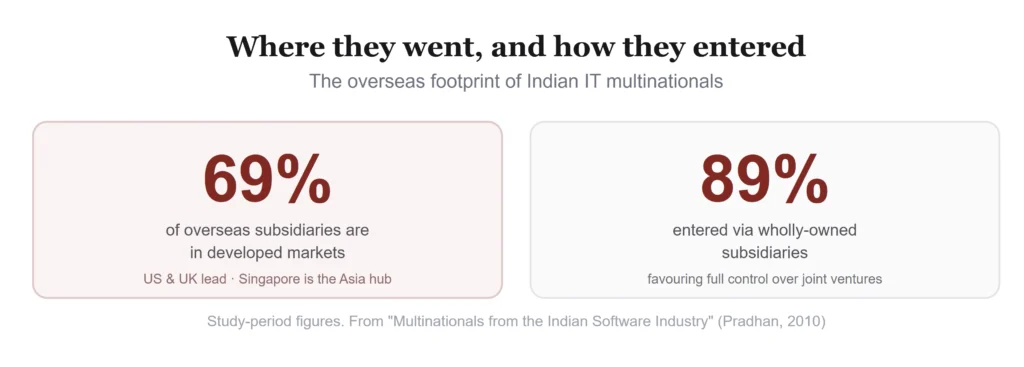
Unlike much emerging-market investment that stays close to home, Indian IT firms went where their clients were: about 69% of their overseas subsidiaries were in developed markets, with the US and UK as primary destinations and Singapore as an Asian hub. And they overwhelmingly chose full ownership — roughly 89% of entries were wholly-owned subsidiaries — supplemented by strategic acquisitions to pick up new capabilities, near-shore development centres, and sales offices in key markets. The preference for control reflects how central proprietary processes and client relationships are to the software-services model.

Two pioneers
The chapter illustrates the journey with two contrasting paths. TCS is the systematic globaliser — a domestic IT pioneer that grew into a global leader through selective partnerships, strategic acquisitions, and a relentless focus on process excellence. HCL is the technology innovator — a firm with hardware roots that moved into software, learned from an early (and bruising) US-market entry, leveraged multinational partnerships, and grew through acquisitions. Same destination, different routes.
Lessons and challenges
The Indian experience offers a template. For policymakers: invest heavily in technical education, create dedicated zones and infrastructure for IT, and encourage global linkages. For firms: build genuine global delivery capability, keep investing in skills, use acquisitions strategically, and balance local roots with global reach. The chapter is candid about what could constrain the next chapter, too — sustaining the supply of skills, moving up the value chain, infrastructure limits, intensifying global competition, and (presciently for 2010) the coming impact of automation.
Read the academic abstract
The dramatic growth of outward FDI from India over the past decade has been led significantly by Indian information and software technology (IST) firms, which have aggressively adopted outward FDI as a competitive strategy for seeking overseas markets, networks, skills, and technologies. This study analyses the factors behind the emergence of these Indian IST firms as multinationals. Applying the framework of the national innovation system (NIS), it shows that the origins of Indian IST multinationals are critically linked to the overall policy environment and to strategic government intervention in skill formation and the development of supporting institutions, to the proactive role of Indian households in investing in human capital and supplying risk-taking entrepreneurs, and to firm-level business strategies. The Indian experience suggests that building a suitable NIS is necessary for other developing countries aspiring to build capability in the IST industry.Cite this chapter
Pradhan, J. P. (2010). Multinationals from the Indian software industry. In N. S. Siddharthan & K. Narayanan (Eds.), Indian and Chinese Enterprises: Global Trade, Technology and Investment Regimes (pp. 180–210). London & New Delhi: Routledge. https://doi.org/10.4324/9780367817886-10
Related on this site
- The bigger story of Indian firms going global: India Goes Global: The Rise and Evolution of Indian Multinational Enterprises
- How IT came to lead India’s outward investment: From Local to Global: The Transformation of Indian Multinational Companies
- What “global” really means for these firms: Emerging Giants: How Indian Multinationals Are Shaping the Global Economy
Further Reading


As an Amazon Associate I earn from qualifying purchases.