

| Type | Research monograph (book) |
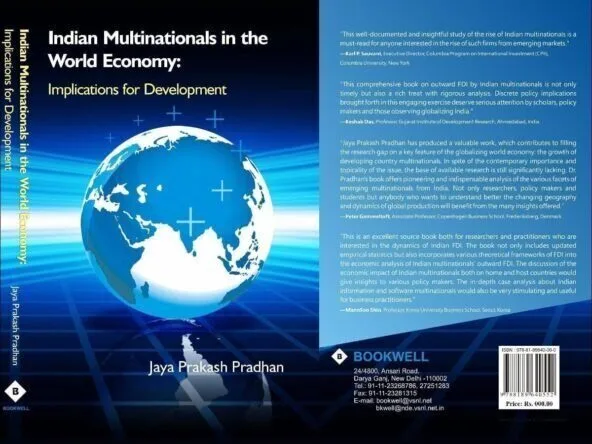
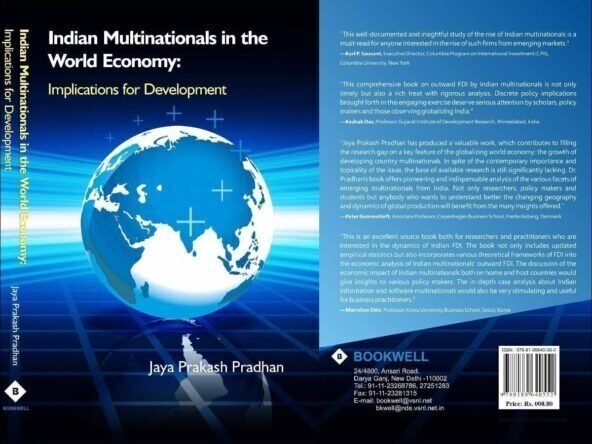
| Title | Indian Multinationals in the World Economy: Implications for Development |
| Author | Jaya Prakash Pradhan |
| Published | 2008 · Bookwell, New Delhi |
| Coverage | Indian outward FDI, 1970s–2008 · quantitative analysis + case studies |
| Read | Google Books preview · Buy on Amazon |
This is a plain-language summary of Indian Multinationals in the World Economy: Implications for Development, my 2008 book (Bookwell) on the long-run rise of Indian outward investment.
In short:
- In a single generation, Indian firms went from cautious, minority-stake ventures in neighbouring countries to majority owners acquiring companies across the developed world.
- The clearest sign is the acquisition wave: from 33 deals worth under $1 billion in 2000 to 123 deals worth $32.8 billion by August 2007.
- Contrary to the common fear, going global did not hollow out jobs at home — firms investing abroad tended to hire more (and higher-skilled) workers in India, and to export more.
From cautious local players to global challengers
For two decades after the 1970s, Indian firms abroad were tentative: mostly small, family-run ventures, staying close to home in other developing countries, usually as minority partners, under a tightly regulated regime. Total overseas investment was just $90 million by 1986 — pocket change in global terms. Three things held firms back: government restrictions on moving capital, a comfortable protected home market, and still-maturing technological capabilities.
Liberalisation in 1991 changed everything. The number of Indian companies investing abroad jumped from 187 in 1991 to about 1,700 by 2003, and outward investment climbed from millions into billions ($16.4 billion by 2006). Three deeper shifts sat underneath the numbers: from followers to leaders (copying Western products gave way to creating new ones — Indian pharma moved from making generics to discovering drugs); from East to West (by the mid-2000s, 41% of investment went to developed countries); and from partners to owners (by 2001, 70% of ventures involved 80%-plus ownership).
The acquisition wave
Nothing captures the change like cross-border acquisitions. Indian companies stopped merely competing with global incumbents and started buying them.

Notably, 2007’s $32.8 billion came from fewer deals than 2006 — the value was concentrated in a handful of mega-deals, above all Tata Steel’s $13.7 billion purchase of Corus. Three kinds of acquirers led the charge:
| Sector | Share of deals | What they were after | Signature deal |
|---|---|---|---|
| IT services | 84% of service-sector deals | customer access and new capabilities | Wipro–Infocrossing ($600M) |
| Pharmaceuticals | 30.85% of manufacturing deals | research facilities, brands, market access | (moving up the value chain) |
| Metals & manufacturing | the largest deals by value | global scale and reach | Tata Steel–Corus ($13.7B) |
And they shopped overwhelmingly in rich countries — the United States most of all:

The IT story in miniature: TCS
No firm embodies the arc better than Tata Consultancy Services. It began in 1968 as an eight-person division of the Tata group, won its first international client (Burroughs) in 1974, and opened its first US office in 1979. The Y2K boom of the late 1990s turned it from a data-processing contractor into a global-delivery specialist — exports reached 70% of revenue. By 2006, TCS operated in 47 countries, earned $2.5 billion, employed 62,832 people, and drew 57.5% of sales from foreign subsidiaries.
Did going global cost jobs at home?
One of the book’s most important findings answers a common worry directly. Far from exporting jobs, Indian firms that invested abroad tended to hire more at home, and to create higher-skilled roles — global project managers, research scientists, international marketing teams. Overseas subsidiaries also pulled exports along behind them, sourcing from India and opening new markets, while bringing home technology, management practices, and quality standards. The relationship ran as a virtuous cycle, not a trade-off.
From controller to enabler: the policy shift
The state’s role was transformed. Through the control era (1969–1992), overseas investment meant mandatory local partners, restrictions on moving cash, and approvals from multiple departments — born of foreign-exchange scarcity and balance-of-payments fears. From 1992, an enabling era replaced it: an automatic approval route, permission for full ownership, and an investment ceiling raised from $2 million to $100 million, with new funding options through ADR/GDR issues and foreign loans. Institutions backed the shift — the EXIM Bank was supporting 144 ventures across 45 countries by 2006, and ECGC insured investments against political and currency risks. The book also flags what was missing: with the Indian Investment Centre wound down in 2004, India lacked a central agency to promote outward investment, leaving information support and strategy fragmented.
The balance sheet
| Strengths | Gaps still to close |
|---|---|
| Growing technical capabilities | Global brand recognition |
| Cost advantages | Deeper innovation capability |
| Quality standards | Support infrastructure and institutions |
| Professional management | A coherent OFDI promotion policy |
Why it matters
The rise of Indian multinationals is more than a national success story. It is a working model of how emerging-market firms can become global leaders — moving from low-cost provider to innovator, from minority partner to controlling owner, from South–South investment to South–North flows — while contributing to both home and host economies. The lesson the book draws is that this transformation rested as much on supportive policy and institutions as on corporate ambition.
Read the academic abstract
The emergence of Indian multinationals on the global stage has been a remarkable phenomenon, with their presence growing significantly over recent decades. Indian companies have been active in the world economy since the early 1960s, but it is in the last fifteen years that their number and scale of operations have expanded rapidly. Faced with intensifying global competition following extensive liberalisation, Indian firms strategically embraced outward foreign direct investment (OFDI) as a core part of their business plans. Through both greenfield and brownfield OFDI — establishing new ventures and acquiring foreign companies — Indian enterprises enhanced their growth potential and global competitiveness, and India emerged as a major developing-country source of FDI.This book provides a comprehensive analysis of the rise of Indian multinationals, examining the macro-level factors and firm-level strategies behind the phenomenon and its implications for India and host countries. It investigates Indian overseas investment flows and stocks from sectoral, regional, ownership, and motivational perspectives, with rigorous long-run coverage from the 1970s onwards, and gives particular attention to innovation, entrepreneurial skill, business scale, productivity, and government policy. Combining quantitative analysis with case studies, it offers insights into the behaviour and impacts of these new global actors. For home countries, it highlights the importance of supportive policies and institutional frameworks; for host countries, it illuminates the strategies and impacts of Indian multinationals; and for aspiring Indian firms, it distils lessons from their predecessors’ experience.Cite this book
Pradhan, J. P. (2008). Indian Multinationals in the World Economy: Implications for Development. New Delhi: Bookwell.
Preview on Google Books → · Buy on Amazon →
As an Amazon Associate, purchases made through the Amazon link may earn a commission at no extra cost to you.
Further Reading

As an Amazon Associate I earn from qualifying purchases.