


| Type | Working paper |
| Title | “Quality of Foreign Direct Investment, Knowledge Spillovers and Host Country Productivity: A Framework of Analysis” |
| Author | Jaya Prakash Pradhan |
| Published | 2006 · ISID Working Paper No. WP2006/11 · Institute for Studies in Industrial Development, New Delhi |
| Focus | A framework for measuring FDI quality — not just quantity — in spillover analysis |
| Read | Working paper (PDF) |
This is a plain-language summary of “Quality of Foreign Direct Investment, Knowledge Spillovers and Host Country Productivity: A Framework of Analysis” (Pradhan, ISID Working Paper No. WP2006/11, 2006).
In short:
- Most research on FDI treats all foreign firms as interchangeable. This paper argues they’re not — they differ in quality, meaning how much benefit (knowledge spillover) they actually pass to the host economy.
- It identifies five quality dimensions and proposes a practical method to measure them: a composite index, with a median (50th-percentile) cut-off separating “high-” from “low-” quality FDI.
- Applied to Indian manufacturing, it finds high-quality FDI generates substantially larger spillovers than low-quality FDI — a difference that simply counting FDI dollars completely misses.
The problem with treating all FDI alike
For decades, studies of foreign investment’s benefits have implicitly assumed that one dollar of FDI is much like any other — that any foreign firm entering a developing country brings broadly similar benefits. This working paper by Jaya Prakash Pradhan challenges that assumption directly. In reality, foreign firms are heterogeneous: some build deep local roots, do research locally, and source from domestic suppliers, while others run thin assembly operations importing most of what they use. Lumping them together, the paper argues, is a real flaw in the spillover literature — and it can produce misleading conclusions about whether FDI “works.”
Five dimensions of FDI quality
The paper sets out the specific ways foreign firms differ in their spillover potential.
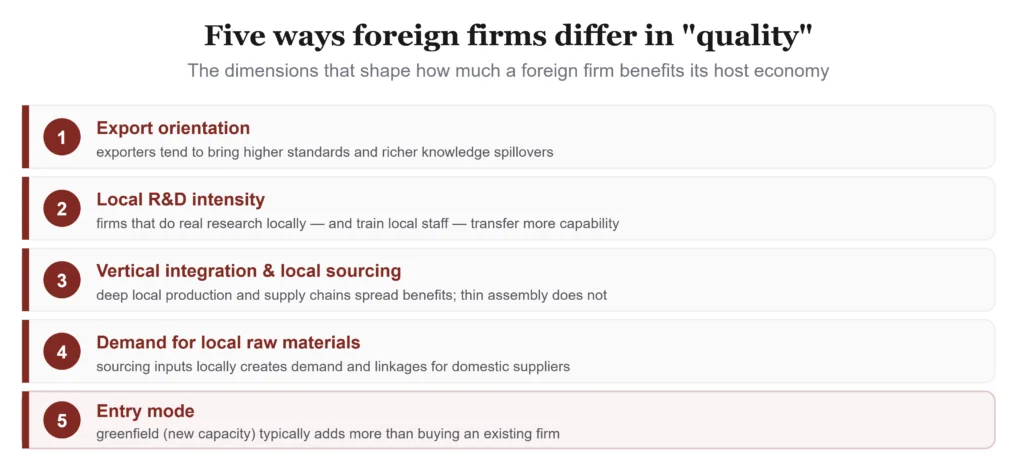
The five dimensions the paper emphasises are: a firm’s export orientation (exporters tend to meet higher standards and generate richer spillovers); its local R&D intensity (firms that actually research and train locally transfer more capability than those importing finished technology); its vertical integration and local sourcing (deep local production spreads benefits; surface-level assembly doesn’t); its demand for local raw materials (local sourcing creates linkages and demand for domestic suppliers); and its entry mode (greenfield investment, which creates new productive capacity, typically adds more than acquiring an existing company). A firm scoring high across these is a very different proposition for the host economy than one scoring low — even if both show up identically in the FDI statistics.
A practical way to measure it
The paper’s methodological contribution is to make “quality” measurable rather than rhetorical.
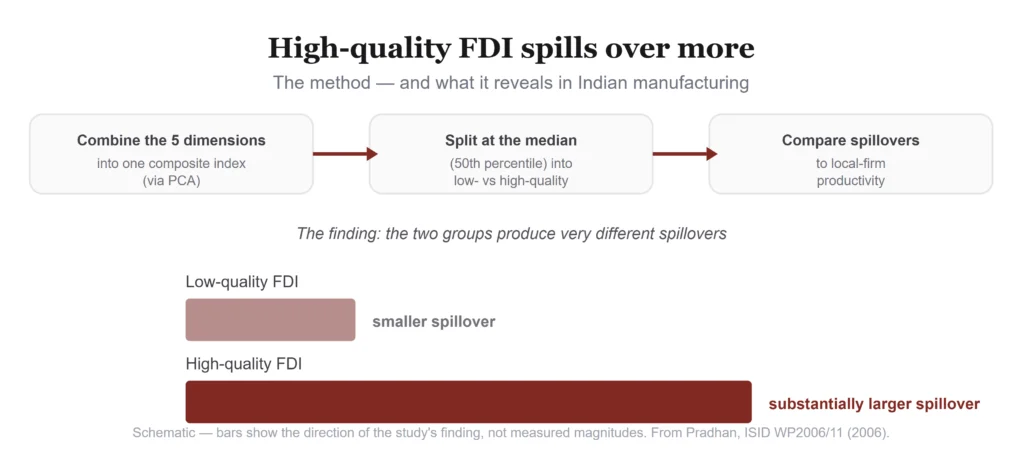
The proposed approach is straightforward in outline: look at how foreign firms are distributed on each quality dimension; combine those dimensions into a single composite quality index using principal component analysis (PCA); use the median (50th percentile) as the dividing line between high- and low-quality firms; and then test how each group’s presence affects the productivity of local firms. It’s a recipe other researchers can apply, not just a one-off result.
What it found in Indian manufacturing
Applying the framework to Indian manufacturing, the paper finds that the distinction matters a great deal: the spillover effects associated with high-quality foreign firms are considerably larger than those associated with low-quality firms, and the gap is even more pronounced at the level of individual industries. The practical implication is pointed — studies that ignore these quality differences, treating all foreign firms as equivalent, are liable to reach misleading conclusions about FDI’s true impact.
Why it matters
The paper’s argument has a clear payoff for both research and policy. For researchers, the message is to build quality measures into spillover analysis rather than treating FDI as homogeneous — otherwise the results can mislead. For policymakers, it reframes the goal: the aim should be to attract high-quality FDI (export-oriented, research-active, locally integrated), not merely to maximise headline FDI inflows, and to design incentives around the quality dimensions that actually generate domestic benefit. It’s a “look at multiple indicators, not just the one number” argument — and a useful corrective to FDI debates that turn entirely on quantity.
Read the academic abstract
Existing research on knowledge spillovers from foreign direct investment (FDI) has tended to treat all foreign firms as homogeneous and of equal importance for host-country development. In actual markets, however, foreign firms are heterogeneous and of varying quality in their potential for knowledge spillovers — differing in export orientation, intensity of local R&D, vertical integration, demand for local raw materials, and entry mode. The omission of such quality dimensions is an important limitation of the existing literature. This paper explores different notions of FDI quality and argues for their inclusion in empirical spillover studies. It develops a framework for incorporating quality dimensions into the analysis of FDI-related spillovers on host-country productivity, and proposes a percentile criterion for distinguishing low- and high-quality FDI firms. Because there are several quality dimensions, the study suggests using principal component analysis (PCA) to build a composite quality index. An empirical exercise constructing an FDI quality index and related spillover variables for Indian manufacturing shows considerable differences between the spillover variables associated with high- and low-quality FDI firms — differences that are more pronounced at the individual-industry level. Unless these quality differences are brought into spillover analysis, the results are likely to yield misleading conclusions.Cite this working paper
Pradhan, J. P. (2006). Quality of foreign direct investment, knowledge spillovers and host country productivity: A framework of analysis (ISID Working Paper No. WP2006/11). New Delhi: Institute for Studies in Industrial Development.
Read the working paper (PDF) →
Related on this site
- The companion empirical study where foreign presence helped only capable local firms: The FDI Effect: A Story of India’s Pharmaceutical Productivity
- What foreign firms actually did with exports in India: Beyond Local Markets: The Evolution of Foreign Companies in India
- The macro FDI-and-growth question: Opening the Gates: How Foreign Investment Shaped India’s Growth Story
Further Reading

As an Amazon Associate I earn from qualifying purchases.