


| Type | Edited volume (book) |
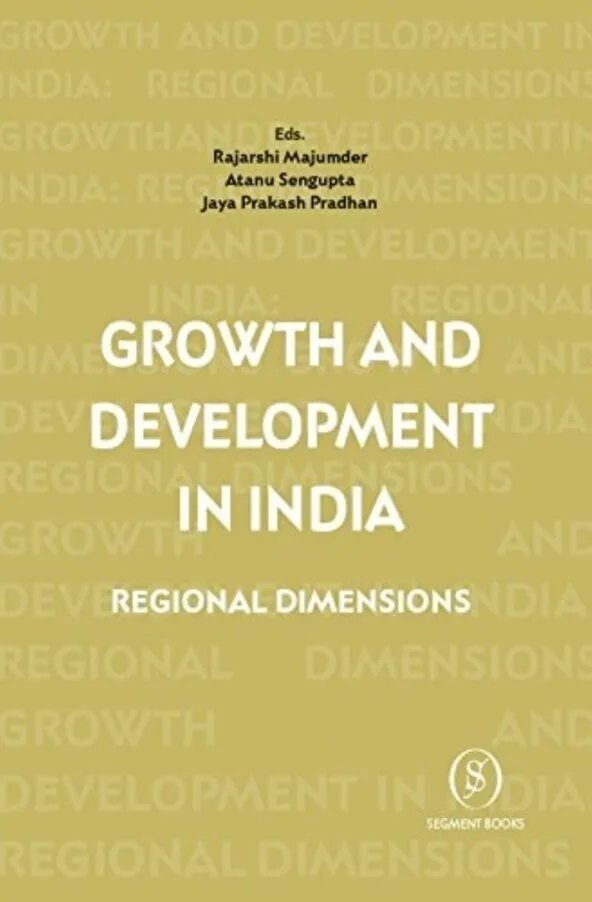
| Title | Growth and Regional Development in India: Regional Dimensions |
| Editors | R. Majumder · A. Sengupta · Jaya Prakash Pradhan |
| Published | 2018 · Segment Books, New Delhi |
| Origins | International conference, Centre for Regional Development & Planning, University of Burdwan (Sept 2015) |
| Scope | 16 chapters · multi-sector · all-India |
| Find it | View on Amazon |
This is an overview of Growth and Regional Development in India: Regional Dimensions, an edited volume I co-edited with R. Majumder and A. Sengupta.
The question behind the book
Why, after decades of planned development, do some Indian regions keep surging ahead while others fall further behind? Regional imbalance is one of the most stubborn problems facing any large developing country, and India is no exception. Small, year-on-year gaps in regional growth rates compound over decades into large differences in living standards — and those differences don’t stay quietly economic. They spill into social and political life, fuelling resentment between regions, demands for autonomy or separate statehood, and pressure to restrict migration from poorer areas to richer ones. This volume asks what drives those persistent gaps, and what it would take to close them.
What the volume covers
Growth and Regional Development in India: Regional Dimensions brings together sixteen chapters that grew out of an international conference hosted by the Centre for Regional Development and Planning at the University of Burdwan in September 2015. Rather than treat regional disparity as a single number, the contributors examine it across many fronts:
- agricultural efficiency and tenancy
- the diversification of rural employment
- forest management and common property resources
- manufacturing and construction
- MSMEs and industrial clusters
- migration patterns
- educational attainment
Together these chapters draw on both primary fieldwork and secondary data to build a layered picture of how unevenly development has reached different parts of the country.
The central argument
The volume’s central insight is that regional inequality is not one problem but many — and that they feed on one another. A region that falls behind on schooling tends to fall behind on incomes; weak infrastructure compounds weak farm–non-farm linkages; gaps in productivity and technical efficiency widen the distance further. The chapters show that economic growth on its own does not pull lagging regions back toward the leaders: convergence happens in some sectors and not others. And where countrywide macroeconomic policies inevitably produce regional winners and losers, the local institutions that might cushion the losers are, in most states, either missing or too weak to matter.

What it means for policy
If disparities are multi-dimensional and self-reinforcing, the volume argues, piecemeal fixes won’t do. Four directions run through the contributions:
Institutions. Stronger, better-resourced local bodies and genuinely bottom-up, coordinated regional policy — rather than development handed down from the top.
Infrastructure. Balanced regional investment in both physical infrastructure and the social infrastructure — schools, health, services — that decides whether growth actually translates into wellbeing.
Human capital. A focus on educational equity, gender-sensitive development, and skilling matched to each region’s needs.
Integration. A measured approach to market integration that protects regional interests and supports local enterprise, rather than leaving lagging areas exposed to competition they cannot yet meet.
Where the research should go next
The contributors are candid about what’s still missing. They call for more fine-grained regional case studies, longitudinal work that can track how disparities evolve rather than freezing them at a single moment, rigorous evaluation of whether specific policies actually work, and analysis that holds the many dimensions of development together instead of studying each in isolation.
Read the academic abstract
Regional development disparities in India persist as a critical policy challenge despite decades of planned intervention. This edited volume, emerging from an international conference, presents sixteen chapters examining the multi-dimensional aspects of regional inequality in India. The contributions span employment diversification, migration, educational attainment, gender parity, financial inclusion, and sectoral development across manufacturing, tourism, and MSMEs. Through empirical analyses using both primary and secondary data, the volume demonstrates how regional inequalities in different spheres reinforce one another, creating persistent development gaps. The findings reveal that while countrywide macroeconomic policies inevitably create winners and losers across regions, appropriate institutional frameworks and safeguards at the local level are either absent or ineffective in most states. The volume identifies weak farm/non-farm linkages, inadequate human-capital development, the neglect of the agricultural sector, and disparities in productivity and technical efficiency as key factors perpetuating regional imbalances. This comprehensive examination offers valuable insights for policymakers, administrators, and researchers working on regional development and inclusive growth in developing economies.Cite this book
Majumder, R., Sengupta, A., & Pradhan, J. P. (Eds.). (2018). Growth and Regional Development in India: Regional Dimensions. New Delhi: Segment Books.
Further Reading

As an Amazon Associate I earn from qualifying purchases.