


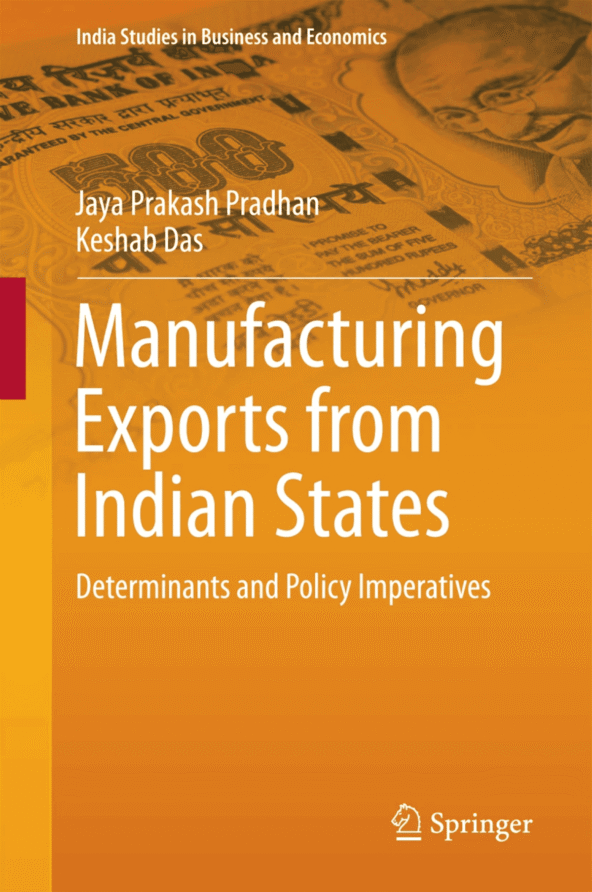
| Type | Research monograph (book) |
| Title | Manufacturing Exports from Indian States: Determinants and Policy Imperatives |
| Authors | Jaya Prakash Pradhan · Keshab Das |
| Published | 2016 · Springer (New Delhi & New York) |
| Data | 8,486 manufacturing firms · ~58% of national manufacturing exports · 1991–2008 |
| Methods | Fractional logit · discrete-time duration (survival) models |
| Read | Springer (DOI: 10.1007/978-81-322-2482-2) |
This is a plain-language summary of Manufacturing Exports from Indian States: Determinants and Policy Imperatives, a research monograph I wrote with Keshab Das (Springer, 2016).
In short:
- By 2008, just two regions — West and South India — produced 76% of India’s manufacturing exports, while resource-rich states elsewhere lagged well behind their potential.
- Export success depends on far more than individual firms: a region’s technological capacity, infrastructure, urban agglomeration, and state policy all shape who exports and how much.
- Exporting is fragile — over half of new export ventures stop within three years — so the real challenge is not just helping firms start exporting, but helping them survive.
The big picture
When India opened its economy in the 1990s, trade went from a modest contributor to a central pillar — today it accounts for roughly 42% of GDP. But the national story hides a sharp regional divide. By 2008, the western powerhouses of Gujarat and Maharashtra and the southern hubs of Karnataka and Tamil Nadu together produced more than three-quarters of the country’s manufacturing exports. Other regions, despite real resources and potential, contributed far less.

What makes an export champion?
The study finds that successful exporting regions share three ingredients. The first is a knowledge foundation — technological capability, research institutions, and a skilled workforce. The second is an infrastructure edge — modern ports, reliable telecommunications, sound financial institutions, and well-developed urban centres. The third is a policy push — export-focused state policies and sustained investment in business infrastructure. Where these line up, exports follow.
Who actually exports?
Two patterns stand out. First, younger firms tend to export more intensively than older ones — they take more risks, adapt faster to global standards, and chase new markets and technologies. Second, there’s an SME paradox: only about 3% of small and medium enterprises export at all — yet those that do can punch well above their weight, provided they invest in foreign technology, secure quality certifications, locate in industrial clusters, and operate from urban centres.
A tale of three states
The book examines three states whose export trajectories capture the wider story:
| State | What’s working | What’s holding it back | |
|---|---|---|---|
| Gujarat | The merchant exporter | Strong business infrastructure, pro-business policy, excellent ports | Over-reliance on petroleum products, limited SME participation, low R&D investment |
| Karnataka | The strategic innovator | India’s first dedicated state export policy, strong technology focus, balanced industrial base, active SME support | Not highlighted in this study |
| Odisha | The sleeping giant | Rich in natural resources | No consistent industrial policy, infrastructure gaps, weak business-development support — exports lag well behind potential |
The survival challenge
Starting to export is only half the battle; staying an exporter is the harder part. The data show a steep fall-off: 27% of new export ventures stop within the first year, and 51% are gone within three — only about half survive beyond that point. Survival favours firms with adequate size and resources, strong R&D and modern technology, and international partnerships, operating in regions with reliable infrastructure and urban advantages.

What it means
For state governments, the lesson is that export competitiveness is built, not given. That means investing in knowledge infrastructure (research institutions, industry–academia links, technology transfer) and physical infrastructure (ports, telecommunications, urban facilities), and backing both with targeted export policies, certification support, and market intelligence.
For firms, the priorities are practical: upgrade technology, obtain quality certifications, build R&D capability, locate in urban clusters, seek international partnerships, and make full use of available government support.
India’s export success, in the end, isn’t only about resources — it’s about building the ecosystems that let firms compete globally. Some regions have found the formula; others are still writing their chapter.
Read the academic abstract
This study examines the spatial determinants of manufacturing exports in India during 1991–2008, with particular focus on sub-national patterns and the regional factors influencing firms’ export behaviour. Using a novel dataset of 8,486 manufacturing firms that accounts for 58% of national manufacturing exports, the research develops and applies a new methodology for estimating state-level exports by allocating firm-level exports to their locations of production. The analysis reveals significant regional concentration of manufacturing exports, with West India and South India accounting for 76% of national manufacturing exports by 2008. Through fractional logit estimation, the study finds that regional factors — technological knowledge stock, infrastructure quality, urban agglomeration, and specialised industrial structure — significantly influence firms’ export intensity, beyond traditional firm-specific determinants. Analysis of export survival using discrete-time duration models indicates that only 49% of export spells survive beyond three years, with significant variation across regions. The research also examines the export behaviour of SMEs across regions and presents detailed case studies of Gujarat, Karnataka and Odisha to understand how sub-national policies shape firms’ internationalisation. The findings suggest that regional export performance is strongly linked to state-level technological capabilities, infrastructure development, and policy support, and offer policy recommendations for promoting regional export growth in developing economies.Cite this book
Pradhan, J. P., & Das, K. (2016). Manufacturing Exports from Indian States: Determinants and Policy Imperatives. New Delhi & New York: Springer. https://doi.org/10.1007/978-81-322-2482-2
View on Springer → · Buy on Amazon →
As an Amazon Associate, purchases made through the Amazon link may earn a commission at no extra cost to you.
Further Reading
As an Amazon Associate I earn from qualifying purchases.