


| Type | Journal article (empirical study) |
| Title | “R&D Strategy of Small and Medium Enterprises in India” |
| Author | Jaya Prakash Pradhan |
| Published | 2011 · Science, Technology & Society, 16(3), pp. 373–395 · SAGE Publications |
| Data & method | Firm-level R&D in Indian manufacturing, by firm size · three-step censored quantile regression |
| Read | DOI: 10.1177/097172181101600307 |
This is a plain-language summary of “R&D Strategy of Small and Medium Enterprises in India” (Science, Technology & Society, 2011).
In short:
- There is a stark R&D divide by size: 38% of large firms do in-house R&D, but only 16% of medium firms and just 8.5% of small firms — and the SME share has been falling even as large firms’ rose.
- The few SMEs that do innovate share a clear profile — older, exporting, well-connected, and profitable — and cluster in technology-intensive sectors.
- Liberalisation raised the stakes: more competition and tighter resources have left most small firms focused on survival rather than research.
A tale of two business worlds
When India opened its economy in the 1990s, it changed the terms of competition for everyone — but not equally. Large firms had the resources to respond by investing in research; most small firms did not. The result is one of the widest innovation gaps in the economy.
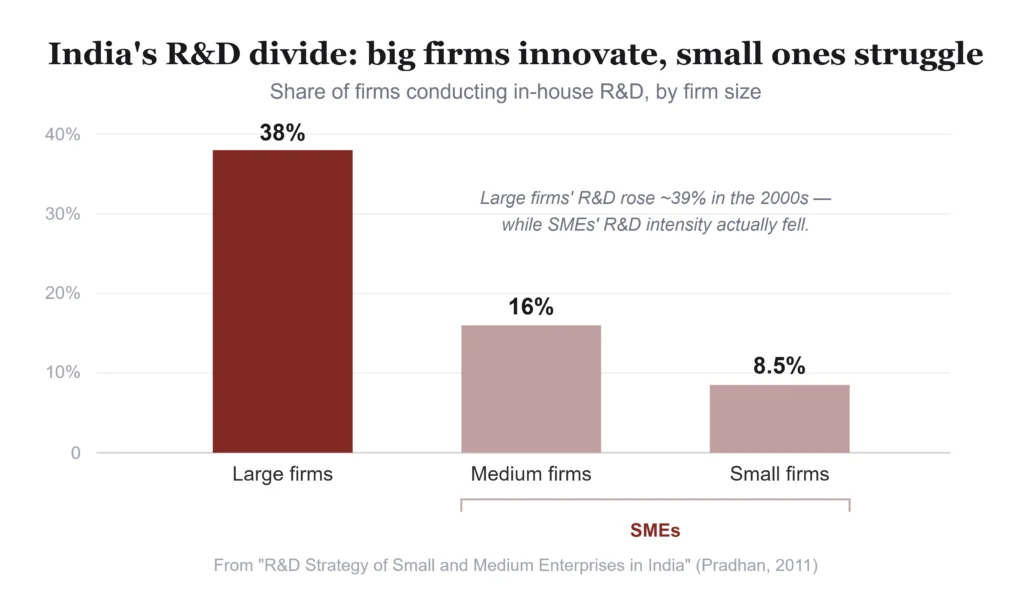
The numbers are blunt. Among large firms, more than a third carry out in-house R&D; among small firms, fewer than one in eleven do. And the gap has been widening: through the 2000s, large firms’ R&D investment rose by around 39%, while the R&D intensity of SMEs actually declined. For the bulk of India’s small businesses — which make up the largest share of industrial units and employment — innovation has taken a back seat to staying afloat.
The paradox: the small firms that punch above their weight
Here is the twist. The minority of SMEs that do invest in R&D often out-innovate much larger firms. They are not a random group — they share a recognisable profile:
| What sets them apart | The innovating SME is… |
|---|---|
| Experience | older and established, with deep industry knowledge |
| Global reach | an exporter that also sources materials internationally |
| Connections | affiliated to a business group or a foreign partner |
| Financial strength | more profitable, with internal funds to invest |
In other words, the SMEs that overcome their size disadvantage do so by borrowing scale from somewhere else — from experience, from global markets, from a corporate group, or from a healthy balance sheet.
Where small-firm innovation concentrates
SME R&D is not spread evenly across industries either. It clusters in the technology-intensive sectors, where the returns to research are highest: chemicals and pharmaceuticals, electrical and optical equipment, machinery and equipment, and transport equipment. These are the spaces where a small firm’s investment in research is most likely to pay off.
What would help
The study points to four levers for narrowing the divide:
| Lever | What it means |
|---|---|
| Finance | Easier access to capital markets, venture capital, and R&D-specific funding |
| Collaboration | Industrial clusters, research partnerships, and knowledge-sharing networks |
| Global integration | Export promotion, international sourcing, and technology transfer |
| Partnerships | Foreign investment and business-group linkages that extend a small firm’s reach |
The underlying message is that small firms can’t close the R&D gap on their own. Whether through finance, clusters, global links, or partnerships, the common thread is helping SMEs reach resources beyond their own walls.
Read the academic abstract
The liberalisation of economic policies over the last two decades, together with intensifying market competition, has become a cause of policy concern for the survival of SMEs in emerging economies like India. These SMEs account for the largest chunk of industrial units and employment in the national economy. Yet most of them compete with deeply inadequate resources, especially weak technological capabilities. This study provides preliminary estimates of SME R&D investment in Indian manufacturing and its broad trends and patterns, and contributes to understanding the factors driving SMEs’ in-house R&D activities. It shows that Indian SMEs remain vulnerable among all firms, as they have the lowest incidence of doing in-house R&D and their R&D intensities have fallen over the last decade. Based on the results of a three-step censored quantile regression, the study suggests a set of policy implications for enhancing SME R&D.Pradhan, J. P. (2011). R&D strategy of small and medium enterprises in India. Science, Technology & Society, 16(3), 373–395. https://doi.org/10.1177/097172181101600307
Related on this site
- A companion study using the same method (censored quantile regression), on where firms do R&D: Why Location Matters: The Geography of Innovation in Indian Manufacturing
- On where small firms are born in the first place: Where Do India’s Small Businesses Thrive? The Geography of Entrepreneurship
- Transnationalization of Indian Pharmaceutical SMEs, which examines how small firms build capability and go global.
Further Reading
As an Amazon Associate I earn from qualifying purchases.