

| Type | Research monograph (book) |
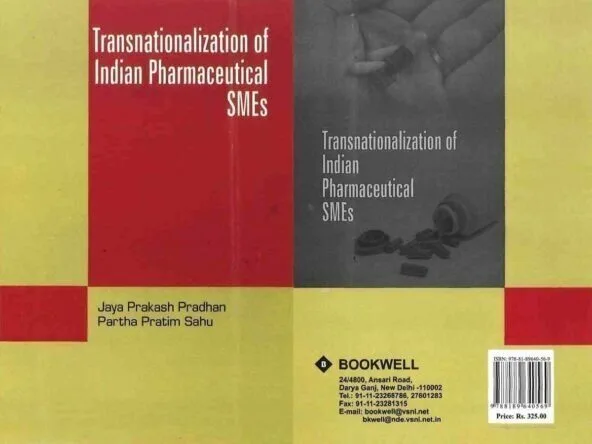
| Title | Transnationalization of Indian Pharmaceutical SMEs |
| Authors | Jaya Prakash Pradhan · P. P. Sahu |
| Published | 2008 · Bookwell, New Delhi |
| Coverage | Indian pharmaceutical SMEs · exports & outward FDI · sector sizing + case studies |
| Read | Google Books preview · Buy on Amazon |
This is a plain-language summary of Transnationalization of Indian Pharmaceutical SMEs, my 2008 book with P. P. Sahu (Bookwell) on how India’s smaller drug firms can compete internationally.
In short:
- Small and medium firms are the backbone of Indian pharma — 91% of companies, 65% of jobs — yet their share of exports collapsed from 37% in 1986 to 2.4% by 2001.
- The firms that broke through abroad share a recognisable formula: invest in R&D within their means, treat quality certification as non-negotiable, find a niche, and use government support well.
- Going global isn’t one leap but a ladder — from a small liaison office to a full overseas factory — and most successful SMEs climb it one rung at a time.
The paradox at the heart of the sector
India’s pharmaceutical SMEs face a hard moment: compete globally or risk being left behind. They are the foundation of the industry, but the export numbers tell a worrying story — their share of pharmaceutical exports fell from over a third in the mid-1980s to barely two percent by 2001, even as large Indian firms went global.

The book locates the cause in a triple constraint: limited financial resources, limited technological capability, and limited policy support. But it also shows the constraint isn’t destiny — a number of small firms have broken through anyway.
What the breakthrough firms did
Across the successful cases, four things recur: innovation (R&D, even at a small scale), quality (Good Manufacturing Practice and international certification), focused marketing (niches and networks rather than price wars), and smart financing. The case studies make the formula concrete:
| Company | Focus | Strategy | Result |
|---|---|---|---|
| Tonira Pharma | generics | invested ~10% of sales in R&D | exports to 40 countries |
| Fermenta Biotech | specialised enzymes | heavy R&D (~9% of sales) | 41% export intensity |
| NGL Fine-Chem | veterinary medicines | ISO + cGMP certification | 70% export intensity |
| Paras Pharmaceuticals | consumer health | subsidiaries in UAE and USA | doubled exports in two years |
| Ozone Pharmaceuticals | — | early GMP adopter | first-mover advantage in regulated markets |
The thread running through them: small R&D budgets and quality certification, used deliberately, can open global doors that size alone would keep shut.
The ladder of going global
Entering foreign markets isn’t a single decision. The book lays out a ladder of entry modes, from the lowest commitment (a liaison office that is little more than a presence) to the highest (a wholly owned overseas factory). Most SMEs begin near the bottom and climb as confidence and resources grow.

Where policy falls short
India offers real support for exporters — venture funding and priority lending, certification and training help, export-promotion councils and trade-fair assistance. The problem is that it doesn’t reach small firms well. The book’s reform agenda is specific:
| The gap | The fix the book proposes |
|---|---|
| Many SMEs unaware of available support | local information centres and online portals |
| Complex, high-collateral financing | simpler, SME-specific export finance |
| Limited access to testing facilities | cluster-based common facility centres |
| Fragmented market intelligence | a centralised export-intelligence system |
A practical path
For a small firm weighing the move, the book sketches a phased route rather than a plunge:
- Assess (3–6 months) — gauge readiness, identify target markets, size up resource needs.
- Prepare (6–12 months) — upgrade quality systems, build an export strategy and the capabilities to deliver it.
- Enter (12–18 months) — start with easier markets, build relationships, learn by doing.
- Expand (18+ months) — deepen the presence, consider foreign investment, build global networks.
The common pitfalls are the mirror image: rushing into hard markets, cutting corners on quality, underestimating what expansion costs, skipping market research, and going it alone instead of using available support.
The bottom line
India’s pharmaceutical SMEs can compete globally — the success stories prove it — but only with a deliberate strategy, a relentless focus on quality, R&D within their means, real networks, and policy support that actually reaches them. The future belongs to firms that can pair the agility of a small company with global standards and reach.
Read the academic abstract
In a rapidly globalising world, India’s small and medium pharmaceutical enterprises (SMEs) face a critical turning point. Once comfortable in a protected domestic market, these firms must now compete globally or risk obsolescence — a transformation that matters not only for corporate survival but for India’s pharmaceutical ecosystem, which depends on SMEs for employment, drug production, and affordable healthcare.This book presents the first comprehensive analysis of how Indian pharmaceutical SMEs can enter global markets through exports and outward foreign direct investment (OFDI). Through empirical analysis and in-depth case studies, it sets out both the obstacles and the opportunities these firms face, breaking new ground by providing the first detailed sizing of India’s pharmaceutical SME sector and applying advanced methods to analyse their export behaviour.The findings challenge conventional wisdom about small firms’ limitations. While pharmaceutical SMEs show significant potential for international expansion, they face a triple constraint — limited financial resources, technological capability, and policy support — and the book shows how some have overcome these barriers through innovation, partnership, and efficient use of available resources. On that basis it proposes a policy framework for SME internationalisation: accessible low-cost finance, stronger links with research institutions, SME-specific incentives, pharmaceutical clusters, and targeted training for global market entry. The result offers practical insight for policymakers, business leaders, and researchers concerned with the internationalisation of small firms in knowledge-intensive industries.Cite this book
Pradhan, J. P., & Sahu, P. P. (2008). Transnationalization of Indian Pharmaceutical SMEs. New Delhi: Bookwell.
Preview on Google Books → · Buy on Amazon →
As an Amazon Associate, purchases made through the Amazon link may earn a commission at no extra cost to you.
Further Reading
As an Amazon Associate I earn from qualifying purchases.