


| Type | Journal article (empirical study) |
| Title | “Liberalization, Firm Size and R&D Performance: A Firm-Level Study of the Indian Pharmaceutical Industry” |
| Author | Jaya Prakash Pradhan |
| Published | 2002 · Journal of Indian School of Political Economy, 14(4), pp. 647–666 |
| Data & method | Indian pharmaceutical firms, 1989–90 to 2000–01 · Tobit analysis |
| Read | Read the paper (PDF) |
This is a plain-language summary of “Liberalization, Firm Size and R&D Performance: A Firm-Level Study of the Indian Pharmaceutical Industry” (Pradhan, Journal of Indian School of Political Economy, 2002).
In short:
- Opening up the economy after 1991 didn’t crush Indian pharma’s research — competitive pressure actually pushed firms to innovate more.
- Firm size and R&D follow an inverted-U: research intensity rises with size, peaks, then declines. The estimated sweet spot is around ₹710 crore (in the study period’s rupees) — bigger isn’t automatically better.
- Counter-intuitively, domestic firms out-invested multinationals in local R&D — 2.6% of sales versus 0.74%.
A test for a transforming industry
In the early 1990s, India’s pharmaceutical industry was a protected market of thousands of mostly small firms making low-cost generics. Liberalisation changed the rules and raised the competitive stakes. This study asks, with firm-level data from 1989–90 to 2000–01, what that did to companies’ research effort — and which kinds of firms responded.
The size puzzle
Does bigger mean more innovative? Only up to a point. The relationship between firm size and R&D intensity is an inverted-U: it climbs as firms grow, reaches a peak, and then falls away again.
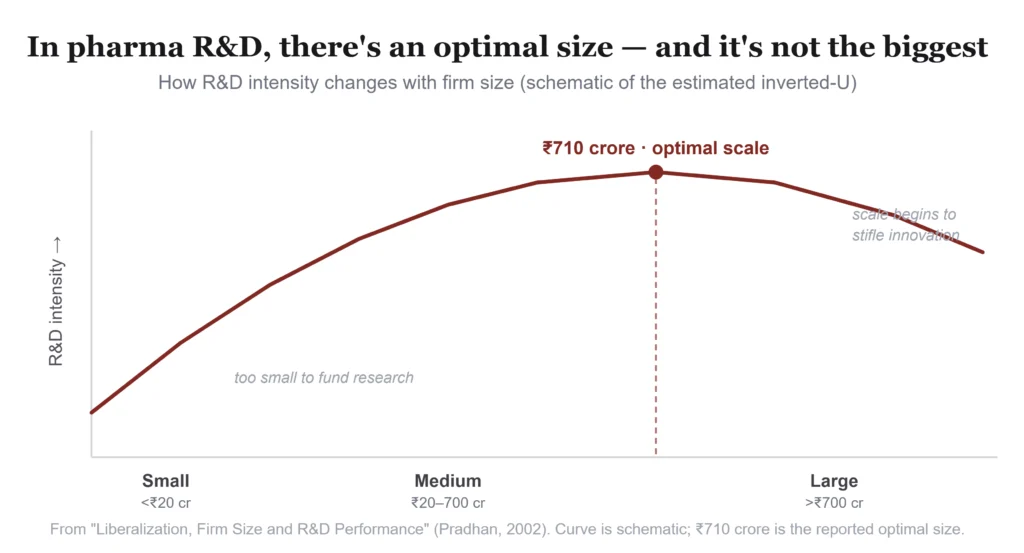
The smallest firms — under ₹20 crore, and nearly half the industry — struggle to fund research at all. Medium-sized firms (₹20–700 crore) show the most dramatic gains in R&D intensity. And the very largest firms, past the estimated optimal scale of around ₹710 crore, begin to see diminishing returns, as size brings bureaucracy that can blunt the innovative edge. The lesson is that there is a right size for research — large enough to fund it, not so large that it ossifies.
Three findings worth a second look
Liberalisation pushed firms toward research, not away from it. The fear in 1991 was that opening up would expose Indian firms and sap their capacity to innovate. The data show the opposite: competitive pressure drove R&D spending up.
Domestic firms out-invested the multinationals. This is the most surprising result. Despite their deeper global resources, foreign multinationals spent less on local R&D than Indian companies did.
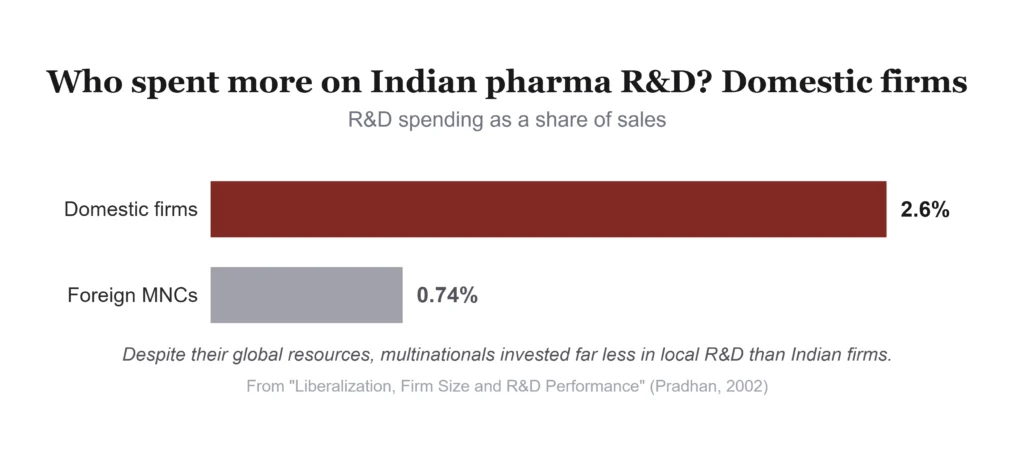
Domestic firms devoted 2.6% of sales to R&D; multinationals, just 0.74%. The multinationals largely conducted their research elsewhere and used India as a market — a finding with direct implications for technology policy.
Outward-looking firms innovated more. Companies engaged in export markets or investing abroad showed higher R&D intensity. Global exposure and the drive to innovate went hand in hand.
What makes a pharma firm innovate
Pulling the firm-level results together, six characteristics raise the odds that a company invests in research:
| Driver | Why it matters |
|---|---|
| Size near the optimum | Enough scale to fund R&D, before bureaucracy sets in |
| Export orientation | Global competition raises the returns to innovating |
| Outward FDI | Investing abroad exposes firms to new technology and standards |
| Intangible assets & brands | A base of know-how to build research on |
| Profitability | Internal funds to invest in long-horizon research |
| Age and experience | Accumulated capability; older firms tend to do more R&D |
What it means
The study’s policy message has three parts: help small firms reach efficient scale through clusters and collaboration; make it easier for firms to export and invest abroad, since outward orientation fuels innovation; and design special R&D support for the small firms that keep essential medicines affordable. It also suggests strengthening public–private research collaboration and using the flexibilities in international trade rules to encourage foreign firms to locate real R&D in India — directly addressing the domestic-versus-foreign gap above.
Read the academic abstract
This paper attempts to empirically verify the impact of economic liberalisation on the R&D behaviour of Indian pharmaceutical firms, controlling for the effects of several firm-specific characteristics including firm size. The results from a Tobit analysis for a sample of firms over the period 1989–90 to 2000–01 indicate that the competitive pressure generated by liberalisation has worked effectively in pushing Indian pharmaceutical firms into R&D activity. A host of firm characteristics — age, size, profitability, intangible assets, export orientation, and outward foreign direct investment — are also found to be important determinants of innovative activity in the industry. The study suggests several policy measures to further the indigenous technological efforts of pharmaceutical firms: removing obstacles that inhibit the outward orientation of firms; providing a special scheme for small firms within the industry’s technology policy; intensifying collaborative research between the private sector and government research institutions; and using flexibilities in trade agreements to persuade foreign firms to relocate R&D units into the country.Cite this article
Pradhan, J. P. (2002). Liberalization, firm size and R&D performance: A firm-level study of the Indian pharmaceutical industry. Journal of Indian School of Political Economy, 14(4), 647–666.
Related on this site
- The same size-and-innovation question, two decades on and across all of manufacturing: The R&D Divide: India’s Small Businesses and Innovation
- How Indian manufacturers acquired technology after 1991, by every channel: The Technology Race: How Indian Manufacturing Evolved in the 1990s
- Transnationalization of Indian Pharmaceutical SMEs, which follows small pharma firms as they build capability and go global.
Further Reading
As an Amazon Associate I earn from qualifying purchases.