

| Type | Working paper |
| Title | “Overseas Acquisition versus Greenfield Foreign Investment: Which Internationalization Strategy Is Better for Indian Pharmaceutical Enterprises?” |
| Authors | Jaya Prakash Pradhan & A. Alakshendra |
| Published | 2006 · ISID Working Paper No. WP2006/07 · Institute for Studies in Industrial Development, New Delhi |
| Focus | Whether acquisition or greenfield investment is the better route abroad for Indian pharma firms |
| Read | Working paper (PDF) |
This is a plain-language summary of “Overseas Acquisition versus Greenfield Foreign Investment: Which Internationalization Strategy Is Better for Indian Pharmaceutical Enterprises?” (Pradhan & Alakshendra, ISID Working Paper No. WP2006/07, 2006).
In short:
- As Indian pharma firms went global, they faced a classic strategic choice: build operations abroad from scratch (greenfield) or buy existing foreign companies (acquisition).
- The paper sets the choice within a four-stage account of how the industry internationalized, then weighs the two modes theoretically.
- Its argument is that acquisition tends to be the stronger strategy — because it delivers what greenfield does and adds market networks, brands, and technology — illustrated through a case study of Ranbaxy.
The strategic choice
An Indian pharmaceutical company ready to expand internationally has two basic ways to plant itself in a foreign market: construct its own facilities and networks from the ground up (greenfield investment), or acquire an existing local company. This working paper, by Jaya Prakash Pradhan and A. Alakshendra, asks which route better suits Indian pharma firms given their particular strengths — and builds toward an answer through theory and a company case study.
How Indian pharma got here
The paper first situates the question in a four-stage history of the industry’s internationalization.
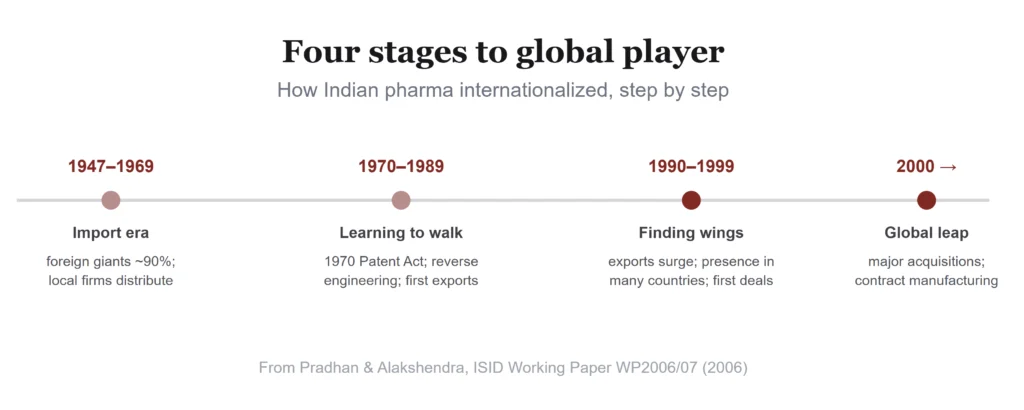
In the import era (1947–1969), foreign companies held roughly 90% of the Indian market and local firms mostly distributed their products. The 1970 Patent Act opened a long second stage (1970–1989) in which Indian firms mastered reverse engineering and began modest exports — Ranbaxy’s early Nigerian joint venture being an oft-cited first step abroad. The 1990s saw exports surge and firms establish a presence in many countries, with the first tentative acquisitions; and from 2000 onward came the “global leap” — major overseas acquisitions and contract manufacturing, as Indian firms became serious international players. A theme the paper stresses is that this whole trajectory was critically shaped by past government policy — the patent regime above all.
Buy or build?
With that history in place, the paper weighs the two modes of going abroad.
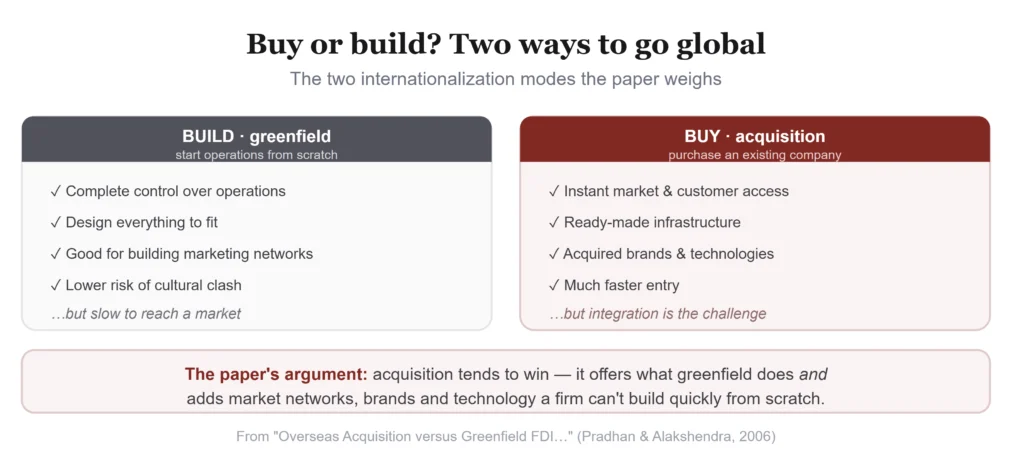
Greenfield investment offers control: a firm builds exactly what it wants, designs its own operations, and avoids the culture-clash risks of merging organisations — useful especially for building marketing networks. Its drawback is speed; growing a market presence from nothing is slow. Acquisition offers the opposite profile: instant access to an existing market and customer base, ready-made (often regulator-approved) infrastructure, and immediate ownership of brands and technologies — much faster entry, at the cost of the hard work of post-deal integration.
The paper’s conclusion is that acquisition is generally the more effective route for Indian pharma firms — and its reasoning is worth stating precisely: acquisition can deliver essentially everything greenfield offers plus additional competitive advantages (established distribution, market networks, intangible assets) that are slow or impossible to build organically. This is a theoretical argument about the relative merits of the two modes, given the kind of ownership advantages Indian pharma firms hold — not a statistical horse-race — and the paper tests it against one detailed case.
The Ranbaxy case study
To ground the argument, the paper examines Ranbaxy Laboratories’ experience with overseas acquisitions. (These are the paper’s illustrative examples from a single firm — telling, but one company’s experience rather than a large-sample result.)
| Acquisition | Market entered | What it brought |
|---|---|---|
| Ohm Laboratories | United States | Instant US-market access and FDA-approved manufacturing; helped develop new products; became profitable relatively quickly |
| Basics GmbH | Germany / Europe | A European foothold; added around 20 products; reported profitable within about three years |
| RPG (Aventis) business | France | A French-market foothold; added around 52 products; still working toward profitability at the time of the study |
Across these deals, the paper’s reading is that acquisitions expanded Ranbaxy’s bundle of intangible assets — distribution and market networks especially — and bought it access to established markets far faster than building from scratch could have.
Why it matters
The practical takeaways the paper draws are that, for Indian pharma firms with the capability to manage it, acquisition deserves to be a primary internationalization strategy — with the real work lying in choosing the right targets and integrating them well — and that policymakers can help by easing financing for overseas acquisitions and building support systems for global expansion. The deeper point, and the one with the widest reach, is the paper’s emphasis that India’s pharma rise was enabled by deliberate policy — a lesson it offers to other developing countries wanting to build a pharmaceutical base of their own.
Read the academic abstract
Overseas acquisition and outward greenfield investment have recently emerged as the two important modes of internationalisation for Indian pharmaceutical enterprises. This study examines the relative strengths and weaknesses of the two strategies to suggest which is more effective for Indian pharmaceutical firms, given the nature of their ownership advantages. The analysis proceeds in three stages. First, the industry’s internationalisation is embedded in a four-stage framework covering inward foreign investment, imports, exports, outward greenfield investment, overseas acquisition, and contract manufacturing including inter-firm strategic alliances. Second, theoretical perspectives are developed on how greenfield investment and overseas acquisition can each maximise the revenue productivity of firms’ competitive advantages and strengthen their competitive position. Third, a case study of Ranbaxy Laboratories assesses its experience with overseas acquisitions. The analysis indicates that the growth and internationalisation of Indian pharmaceutical enterprises depended critically on past strategic government policies, offering lessons to other developing countries seeking to build a domestic pharmaceutical base. The theoretical analysis suggests acquisition is a more effective strategy than greenfield investment, since it provides all the benefits of the latter plus several additional competitive advantages; the Ranbaxy case shows that overseas acquisitions augmented its intangible-asset bundle, including distribution and market networks, and provided access to existing markets.Cite this working paper
Pradhan, J. P., & Alakshendra, A. (2006). Overseas acquisition versus greenfield foreign investment: Which internationalization strategy is better for Indian pharmaceutical enterprises? (ISID Working Paper No. WP2006/07). New Delhi: Institute for Studies in Industrial Development.
Read the working paper (PDF) →
Related on this site
- The pharma industry’s broader competitive rise: The Innovation Race: How Enterprise Size & Policy Shape India’s Pharmaceutical Future
- The patent-and-WTO backdrop to all this: From Patent Protection to Global Health: India’s Pharmaceutical Industry at a Crossroads
- The big-firm acquisition wave Ranbaxy was part of: Going Global: The Rise of Indian Companies on the World Stage
Further Reading
As an Amazon Associate I earn from qualifying purchases.